What are the three subtests of the dMAT Core Module?
The dMAT Core Module has three subtests: Figure Sequences, Mathematical Equations and Latin Squares. They come in this order. Each one has its own clock and gives you 20 tasks in 25 minutes. g.a.s.t. gives the whole module 90 minutes. The table shows each task and how you answer it on our screen.
The task column is in our words, from g.a.s.t.'s preparation material, as of 18 November 2026. Our screens add one thing: every Figure Sequences and Latin Squares question in our 10 full mocks and our practice sets has an animated walkthrough of its answer, and every Core question has numbered steps with a picture for each step. Source: our dMAT practice software, checked in its code on 18 November 2026.
| Subtest | The task | How you answer on our screen |
|---|---|---|
| Figure Sequences | The taskFind the logical pattern in a row of matrices and determine the next two. | How you answerClick the two correct pictures, one under each question mark. The mark needs both. |
| Mathematical Equations | The taskSolve a small system of equations: find the value of each letter. | How you answerType each value into its box, on the on-screen keypad (0 to 9 and delete) or your own keyboard. |
| Latin Squares | The taskComplete a 5 by 5 grid in which each letter appears once in every row and column. | How you answerPick the letter that belongs in the marked cell. |
How do you solve dMAT Figure Sequences?
In dMAT Figure Sequences you see a row of pictures and pick the two that come next. Each picture is a grid with a few symbols in it. Each symbol changes its place, its turn or its colour by its own rule. Follow one symbol at a time, name its rule, then build both missing pictures from those rules.
How to work a task
- Pick one symbol and follow it across every picture before you look at the next symbol.
- Name its rule in a few words: it turns a quarter each step, it moves one cell right, its colour alternates.
- Build the first missing picture from the rules, then the second from the first.
The common trap. Choosing a picture that fits one symbol's rule and not the others. Check every symbol in your pick, for both missing pictures: on our mock the task needs both picks right for its mark.
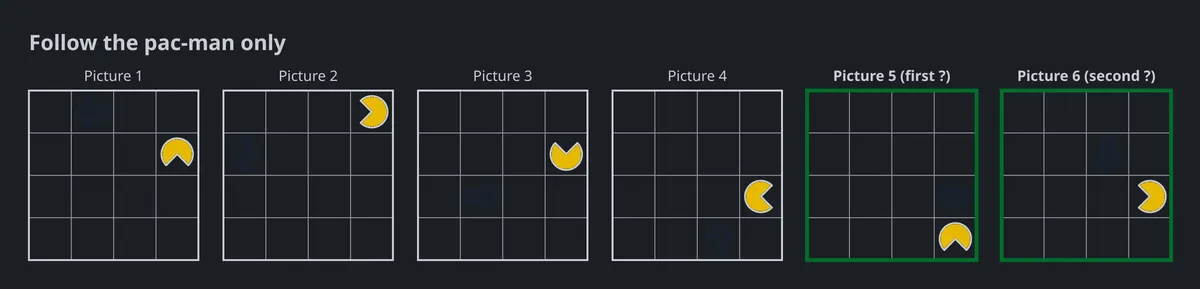
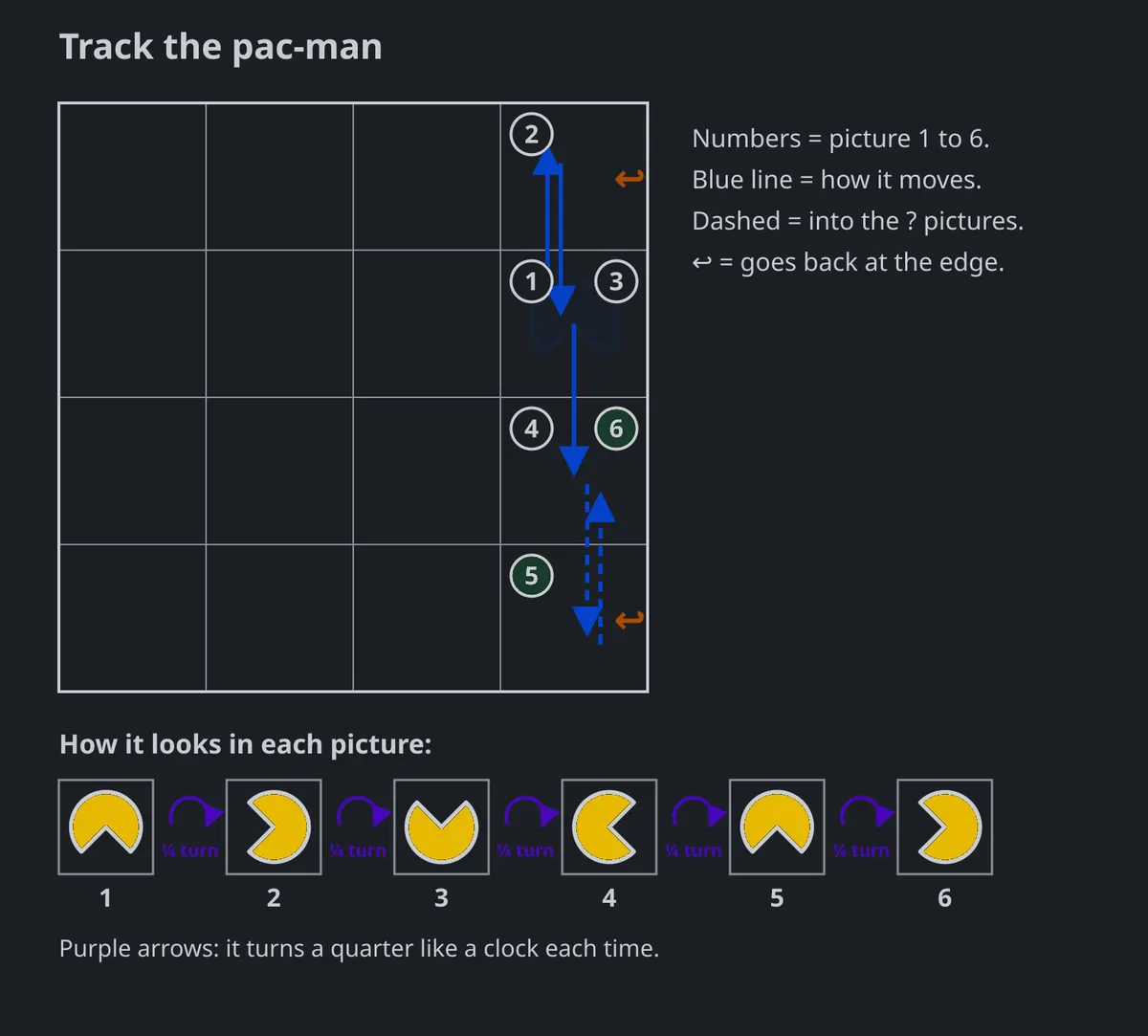
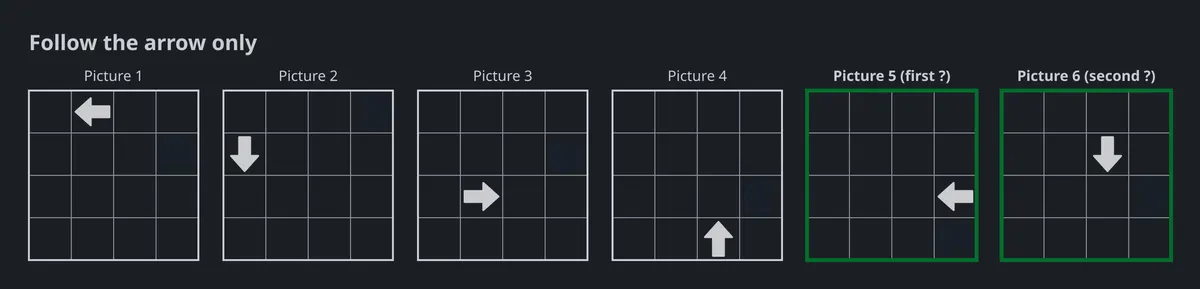
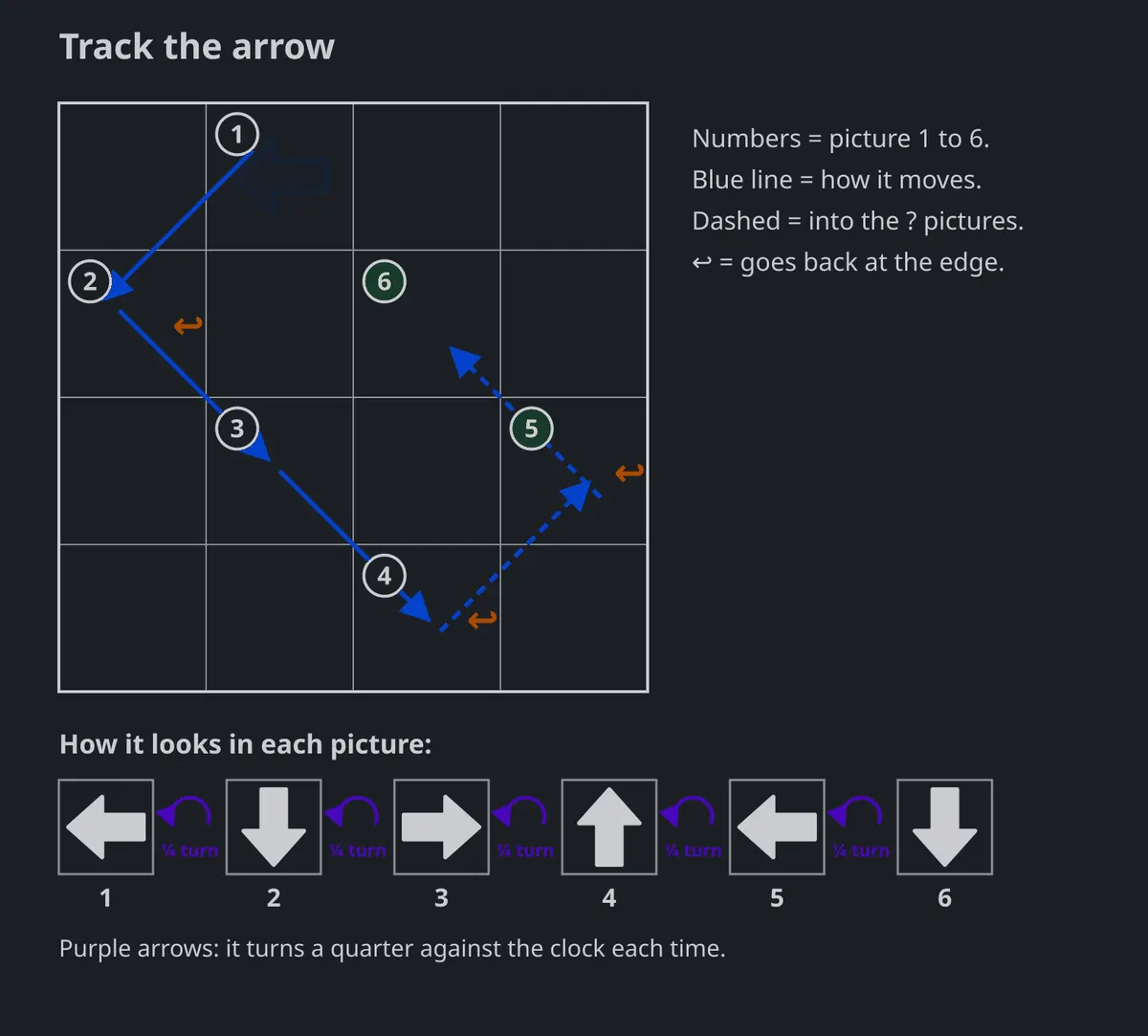
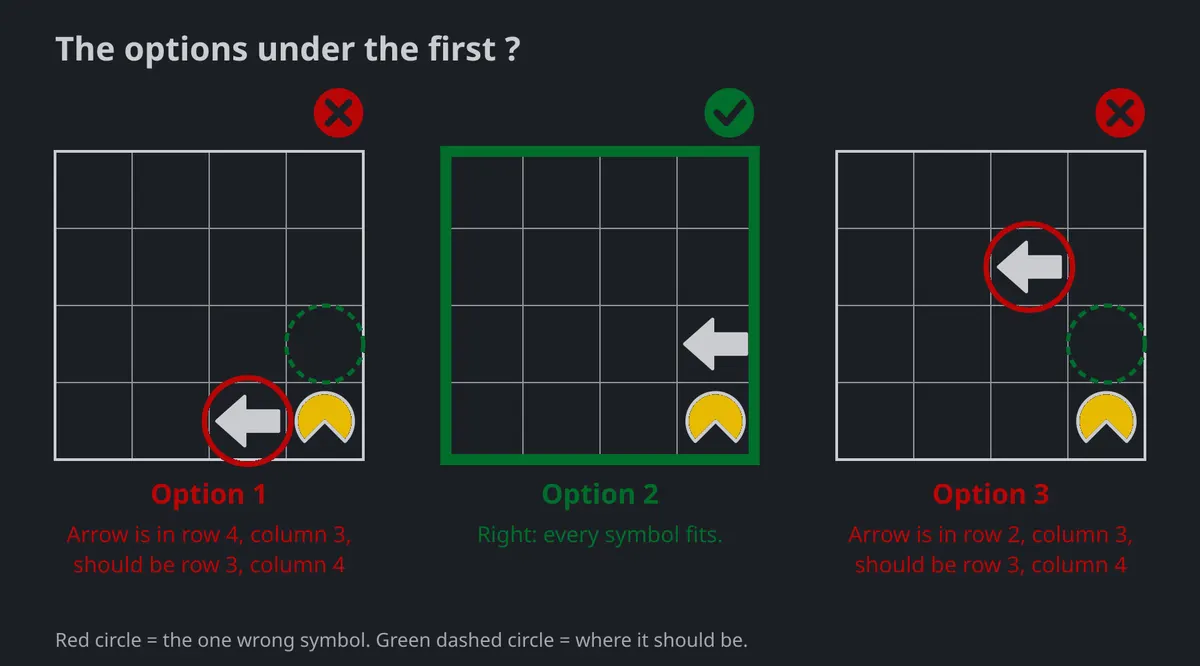
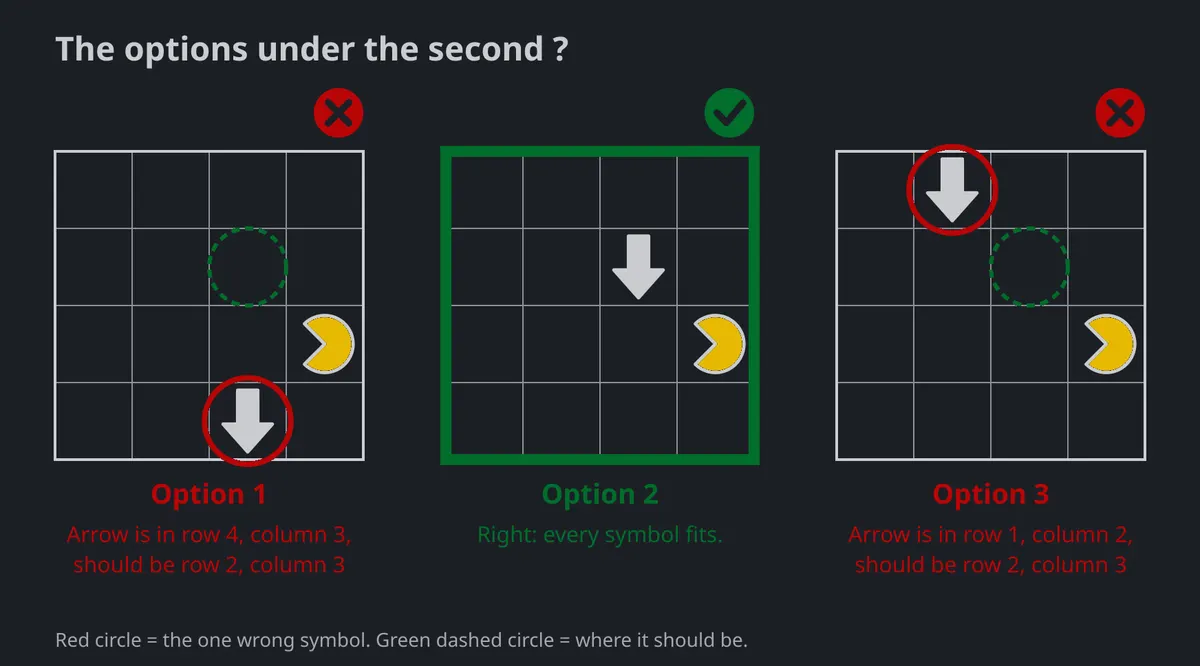
Watch the pattern play out
The walkthrough replays every picture of the row, one at a time, so you see what moves at each step. Then it builds both missing pictures from the same rule.
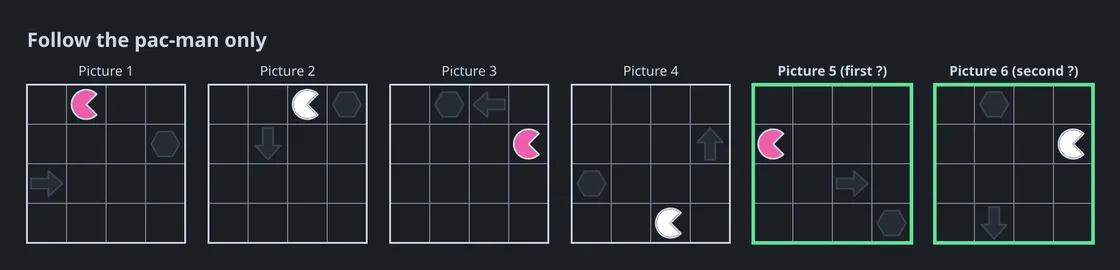
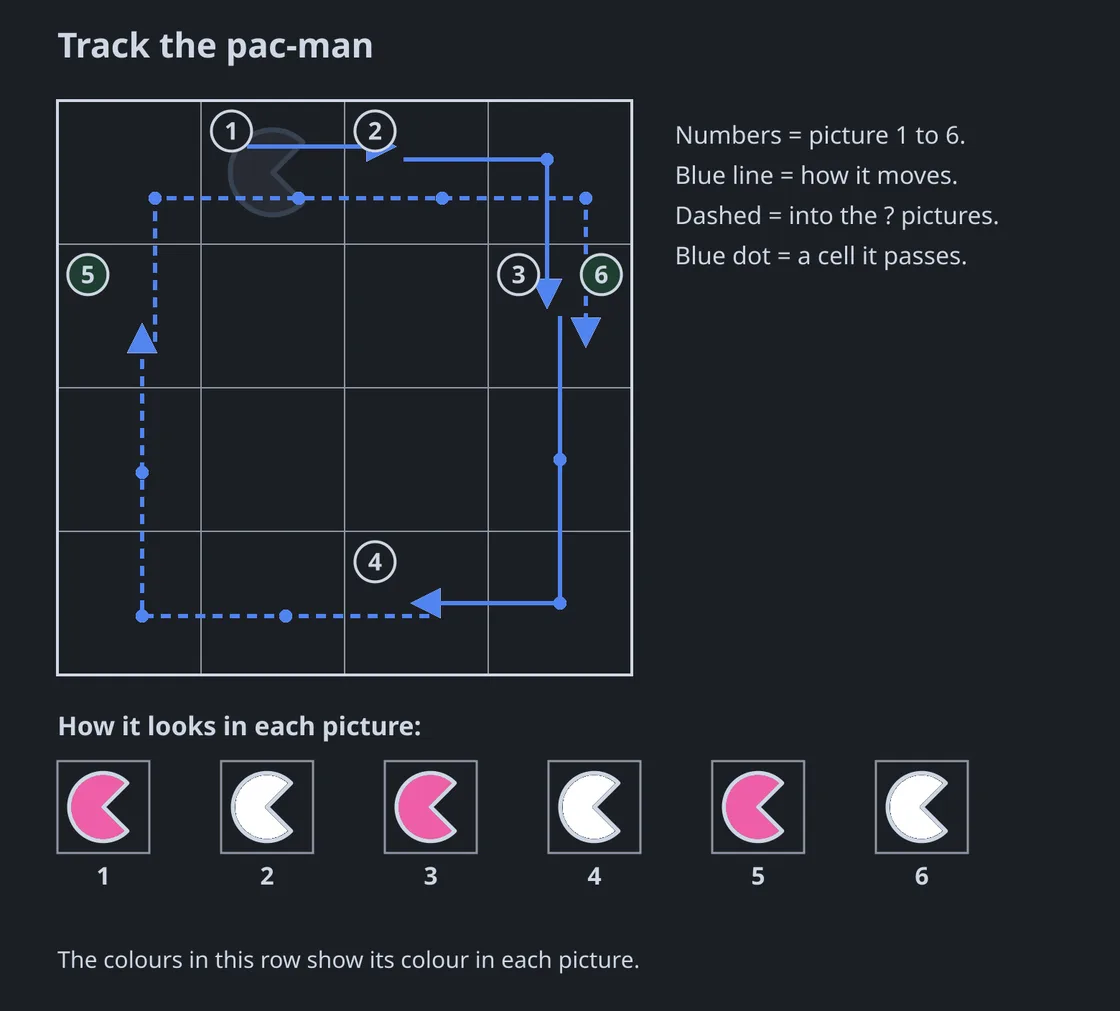
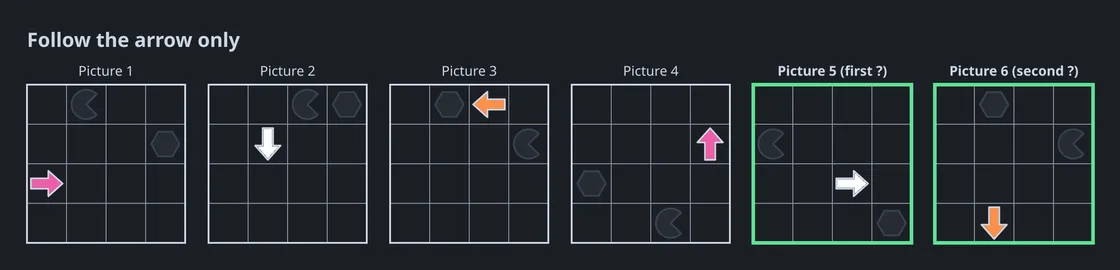
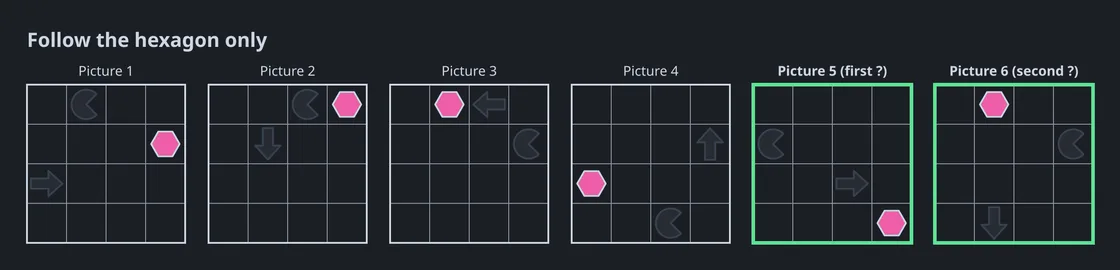
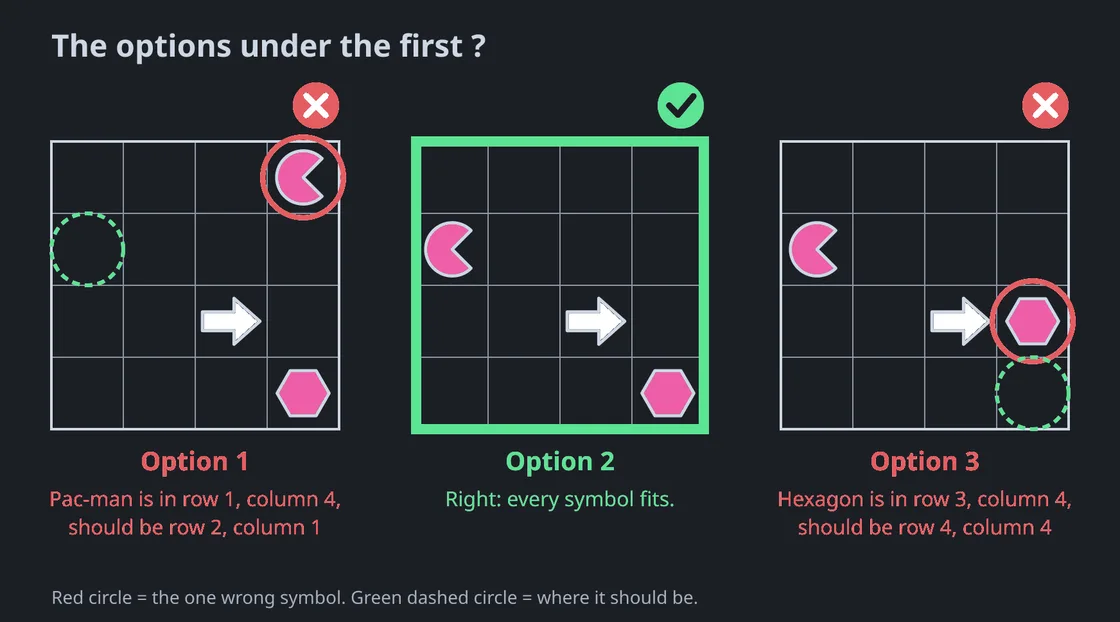
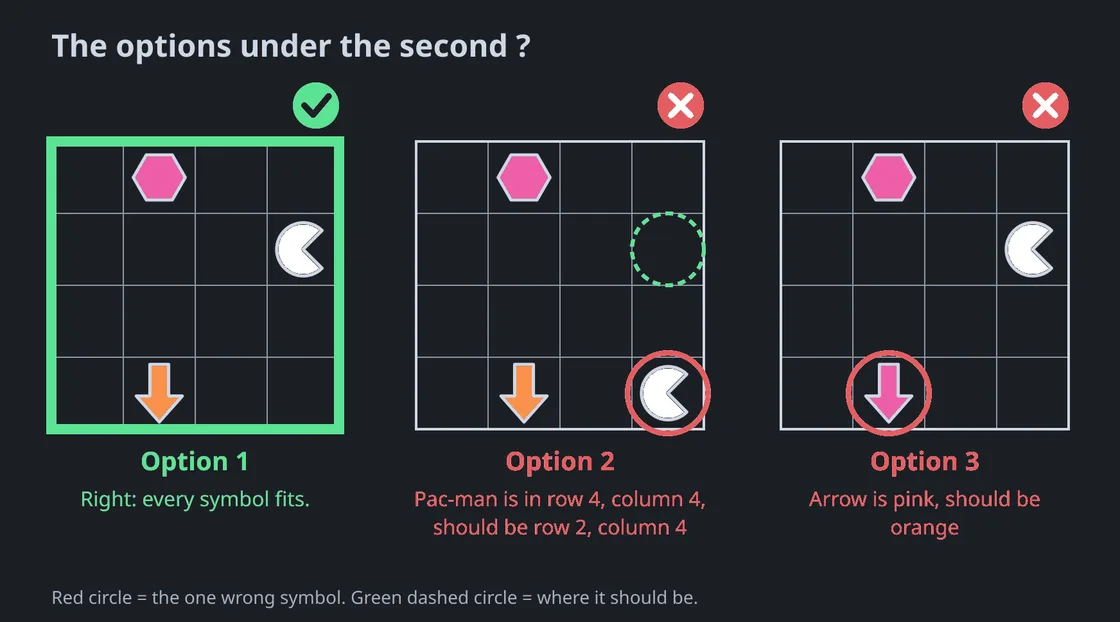
A worked example: the task on sheet 2
Four pictures on a 4 by 4 grid of cells, then two question marks. Each picture holds a pac-man, an arrow and a hexagon.
- Follow the pac-man alone. In picture 1 it is in row 1, column 2, pink. It runs clockwise round the outer ring of cells, 1 cell, then 2, 3, 4 and 5, and swaps between pink and white each time. Picture 5: row 2, column 1, pink. Picture 6: row 2, column 4, white.
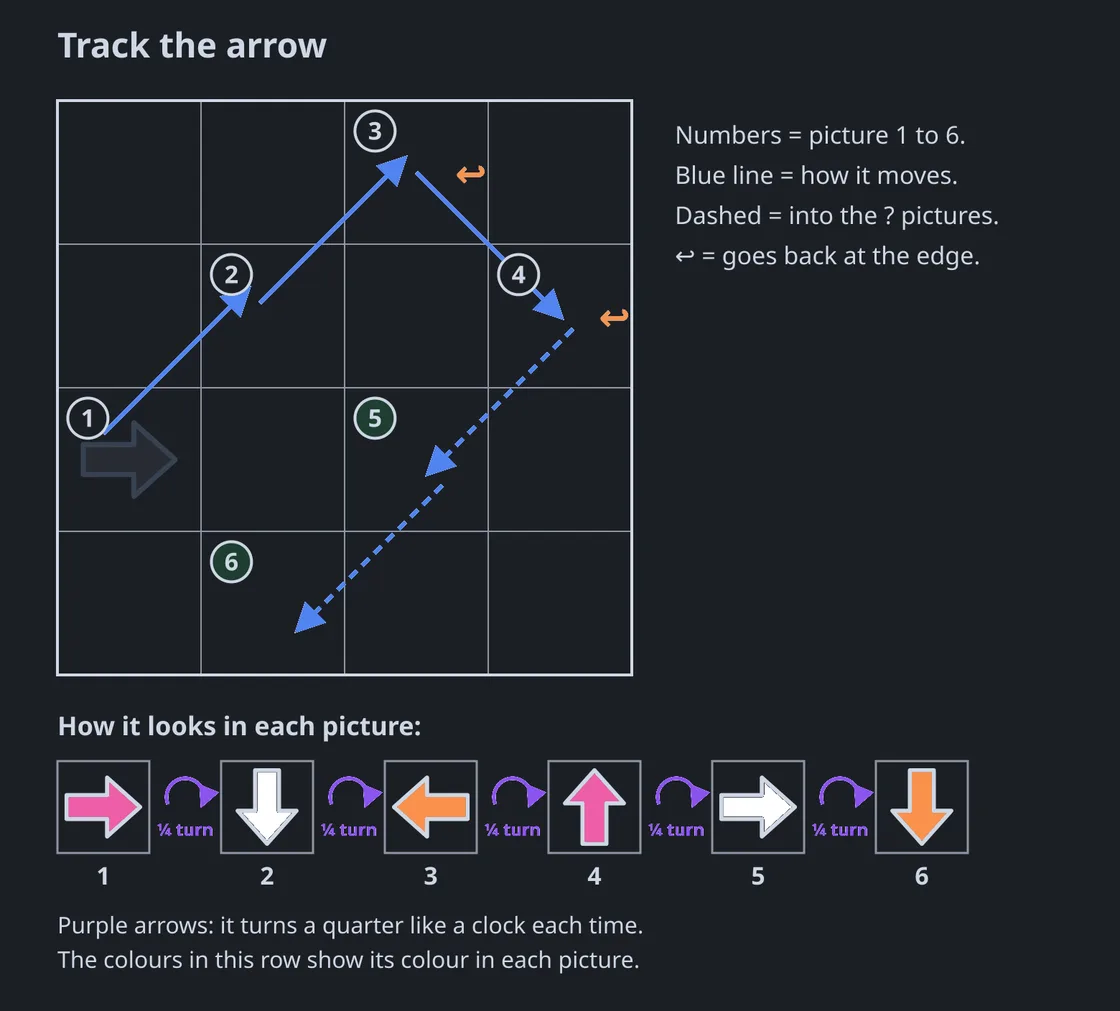
- Follow the arrow alone. In picture 1 it is in row 3, column 1, pointing right, pink. It moves one cell on a slant, up and to the right, and bounces off an edge like a ball. It turns a quarter clockwise each time, and its colour runs pink, white, orange. Picture 5: row 3, column 3, pointing right, white. Picture 6: row 4, column 2, pointing down, orange.
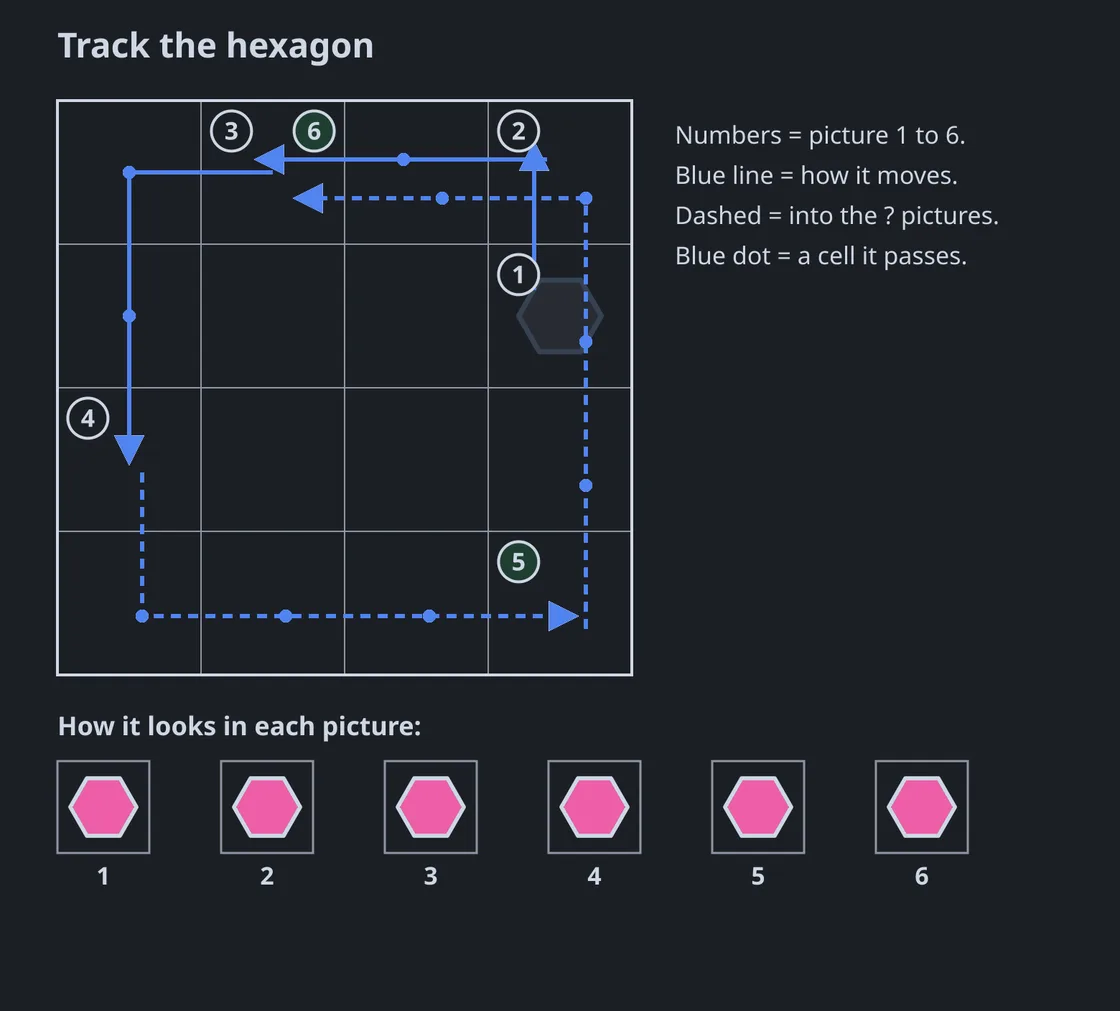
- Follow the hexagon alone. In picture 1 it is in row 2, column 4, pink. It runs anticlockwise round the outer ring, 1 cell, then 2, 3, 4 and 5, and stays pink. Picture 5: row 4, column 4. Picture 6: row 1, column 2.
- Put the three symbols together: that gives pictures 5 and 6, drawn below. Hold each option under a question mark against them. On our screen the wrong options send the pac-man the wrong way round, move the hexagon one cell too far, or leave the arrow pink.
Picture 5
Picture 6
Answer: Picture 5 under the first question mark, picture 6 under the second, as drawn. Check place first, then direction, then colour, and stop at the first mistake.
How do you solve dMAT Mathematical Equations?
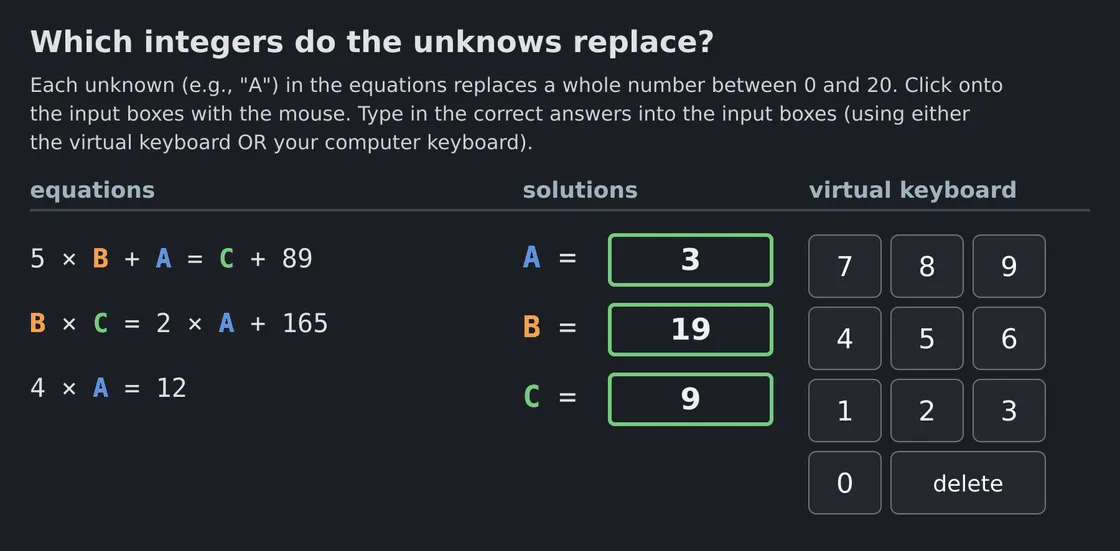
In dMAT Mathematical Equations you get a few equations that share letters, and you find the value of each letter. Start with the equation that has the fewest letters and solve it. Then put that value into the next equation, so only one letter is unknown. Do every sum in your head, because the exam allows no calculator.
How to work a task
- Start from the equation with the fewest letters, often a single letter, and solve it.
- Carry each value into the next equation, so it has one unknown left.
- Check the last value in an equation you have not used yet.
The common trap. Small arithmetic slips. You may not use a calculator in the exam, so one slip early carries into every letter after it.
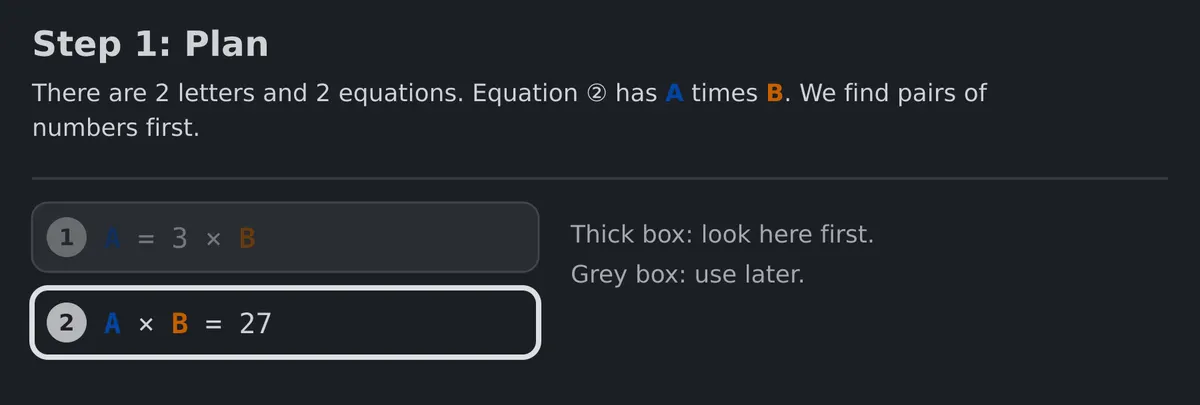
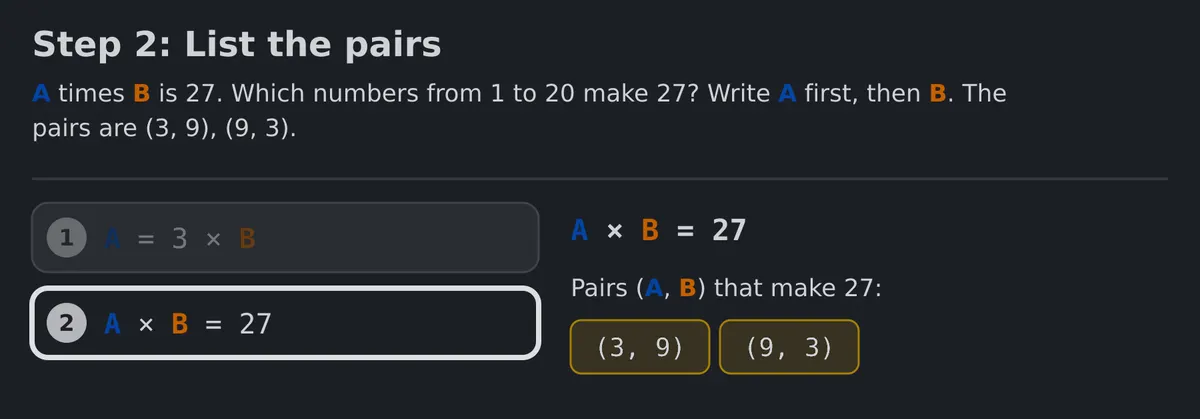
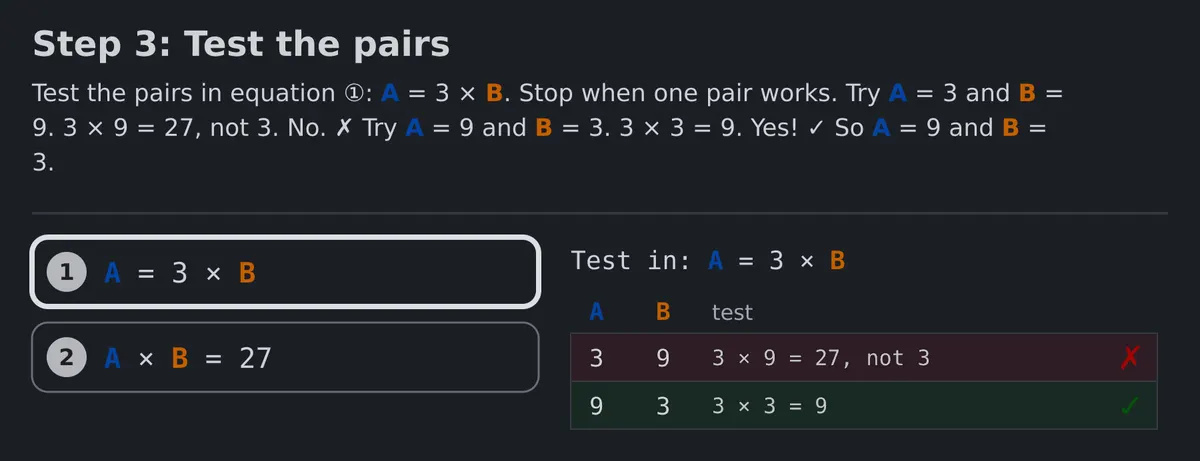
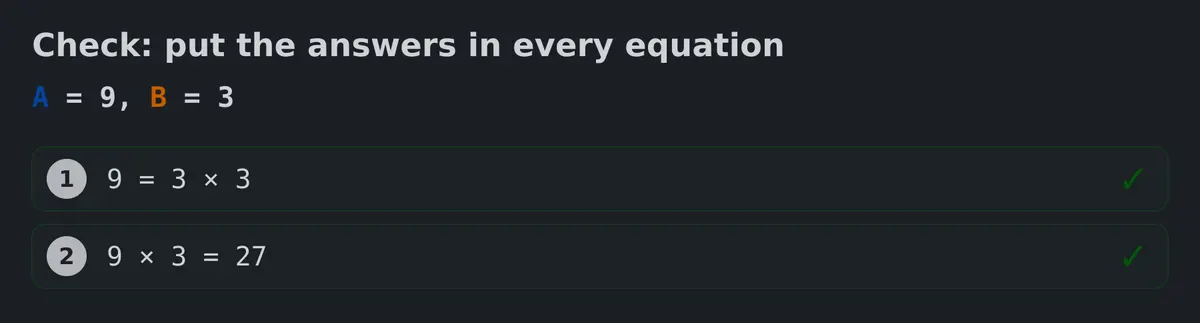
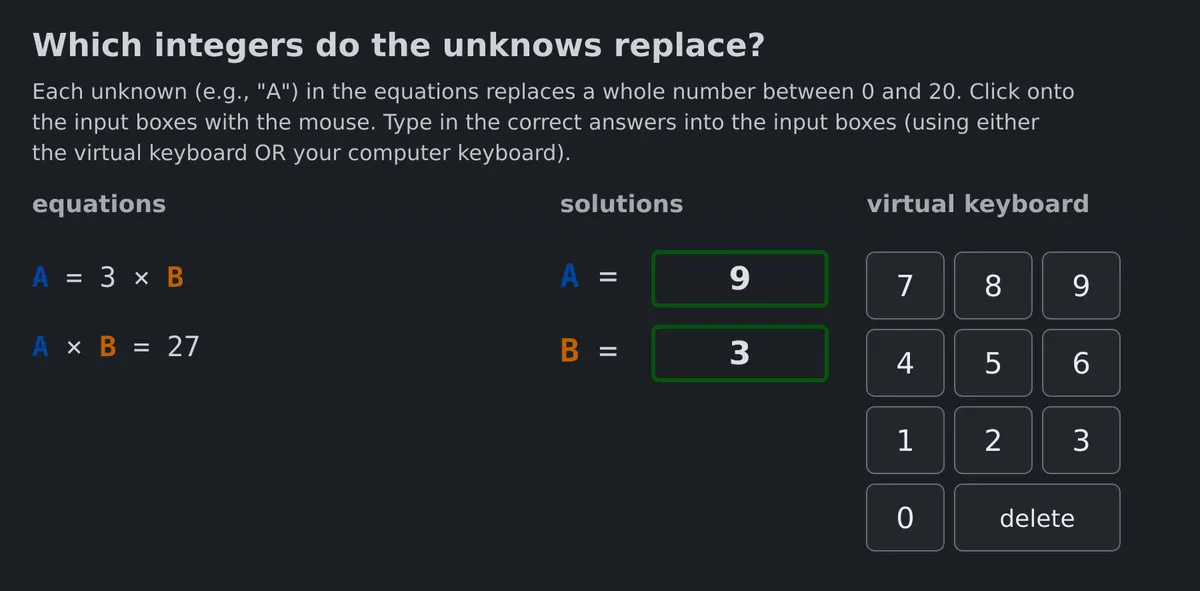
Written steps you can follow
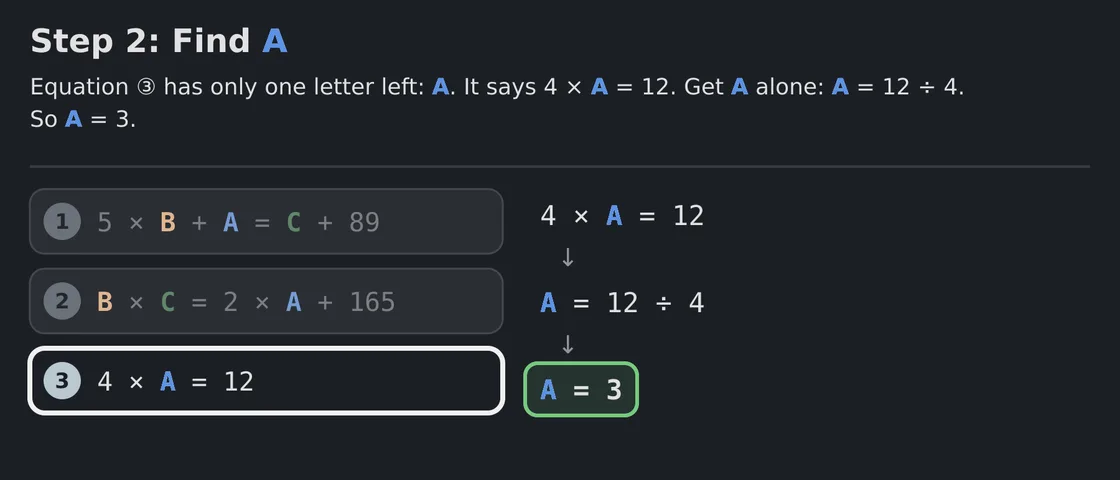
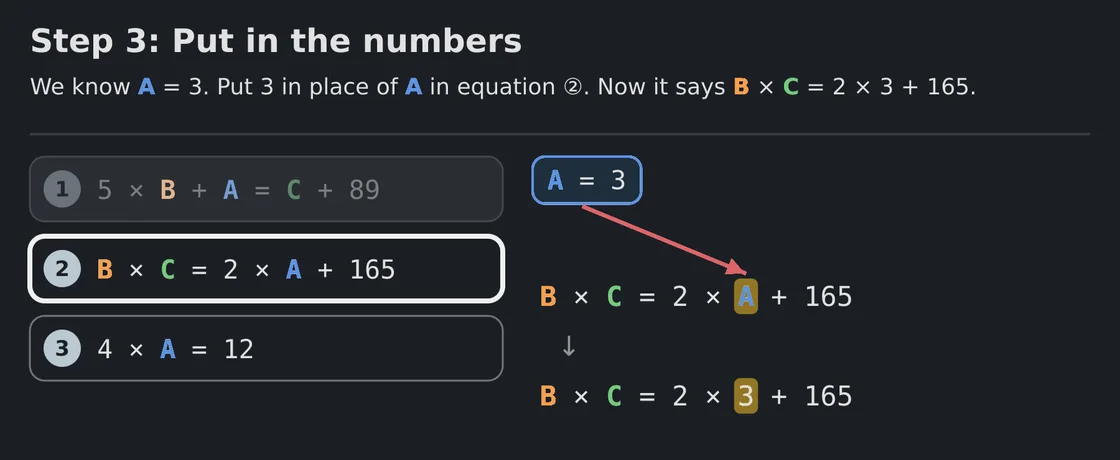
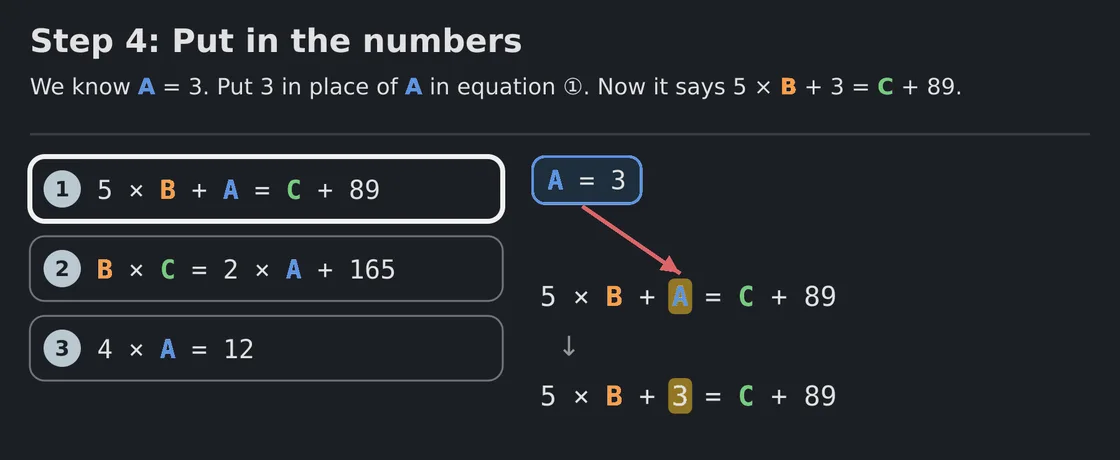
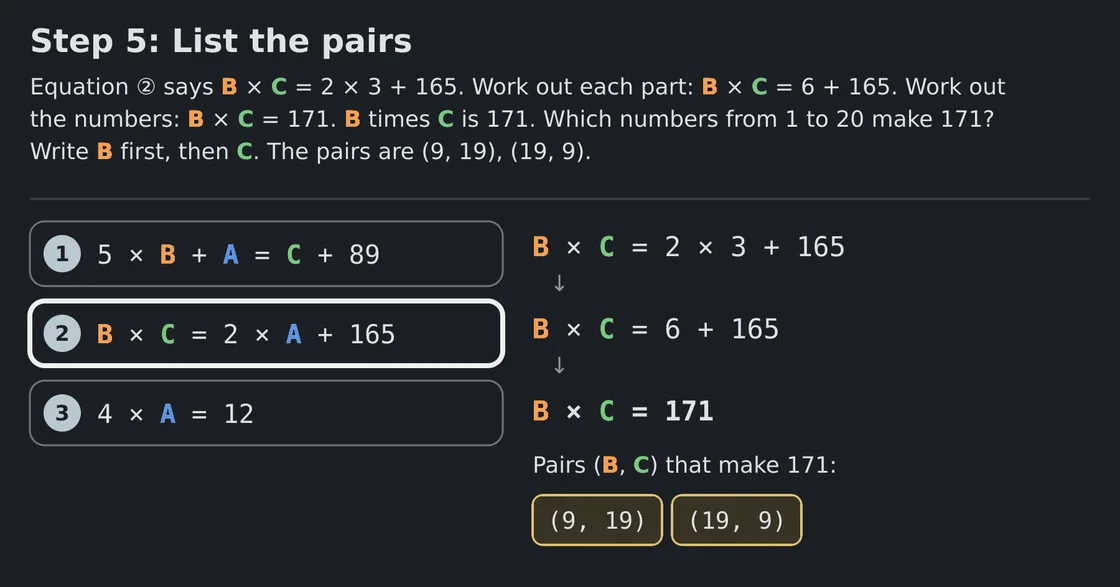
Mathematical Equations has written steps, without the animation: a plan for which equation to start from, then each letter worked out and carried into the next equation.
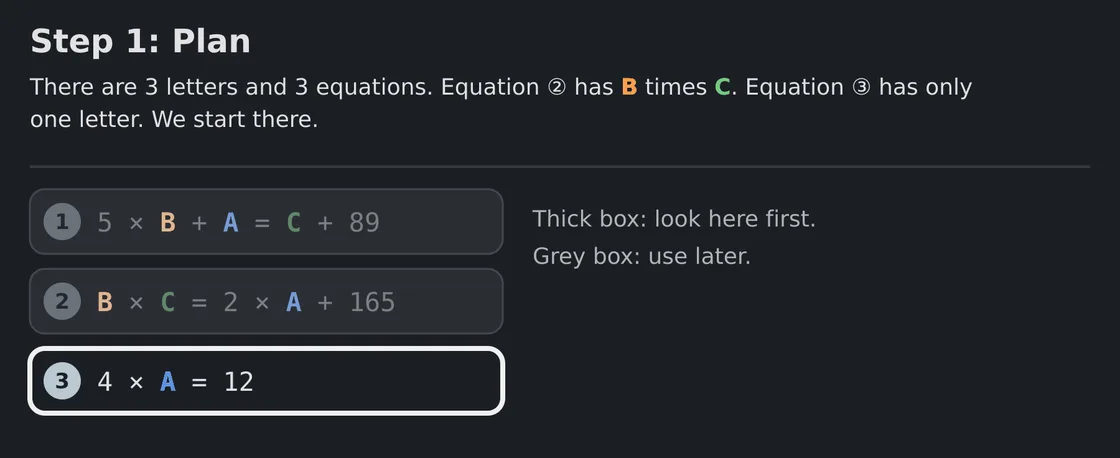
A worked example: the task on sheet 4
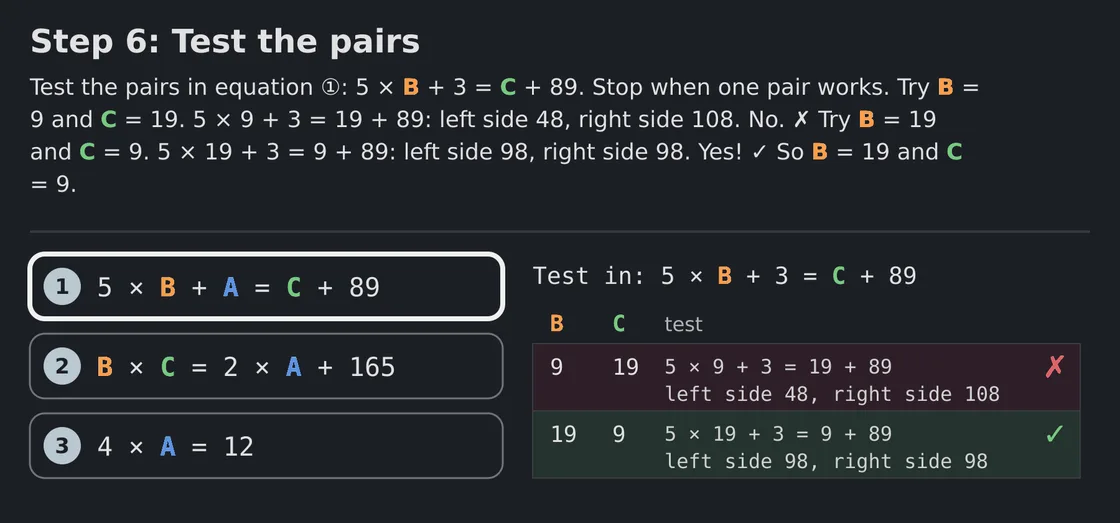
① 5 × B + A = C + 89; ② B × C = 2 × A + 165; ③ 4 × A = 12. Each letter is a whole number from 1 to 20.
- Start with ③, the only equation with one letter: 4 × A = 12, so A = 3.
- Put A = 3 into ②: B × C = 6 + 165 = 171.
- List the pairs up to 20 whose product is 171: 9 and 19, or 19 and 9.
- Test them in ①, which with A = 3 reads 5 × B + 3 = C + 89. B = 9, C = 19 gives 48 against 108: no. B = 19, C = 9 gives 98 against 98: yes.
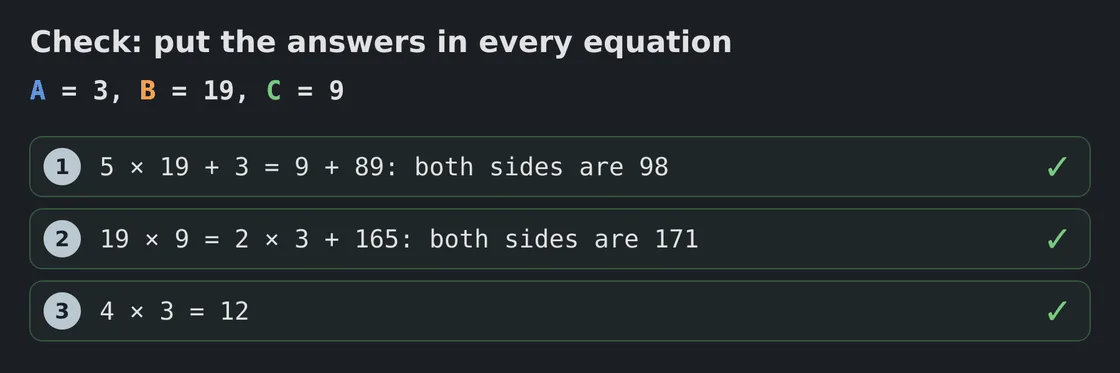
- Check every equation: ① 98 = 98, ② 19 × 9 = 171 = 6 + 165, ③ 4 × 3 = 12.
Answer: A = 3, B = 19, C = 9.
How do you solve dMAT Latin Squares?
In dMAT Latin Squares you see a 5 by 5 grid, partly filled with letters. Each letter appears once in every row and once in every column. You choose the letter for the marked cell. Strike out the letters already in its row, then those in its column. If one letter is left, that is your answer.
How to work a task
- Read the row of the marked cell and strike out the letters it already holds.
- Read its column and strike out those letters too.
- If more than one letter is left, fill a nearby cell with only one choice first.
The common trap. Reading only the row or only the column. The letter must be missing from both.
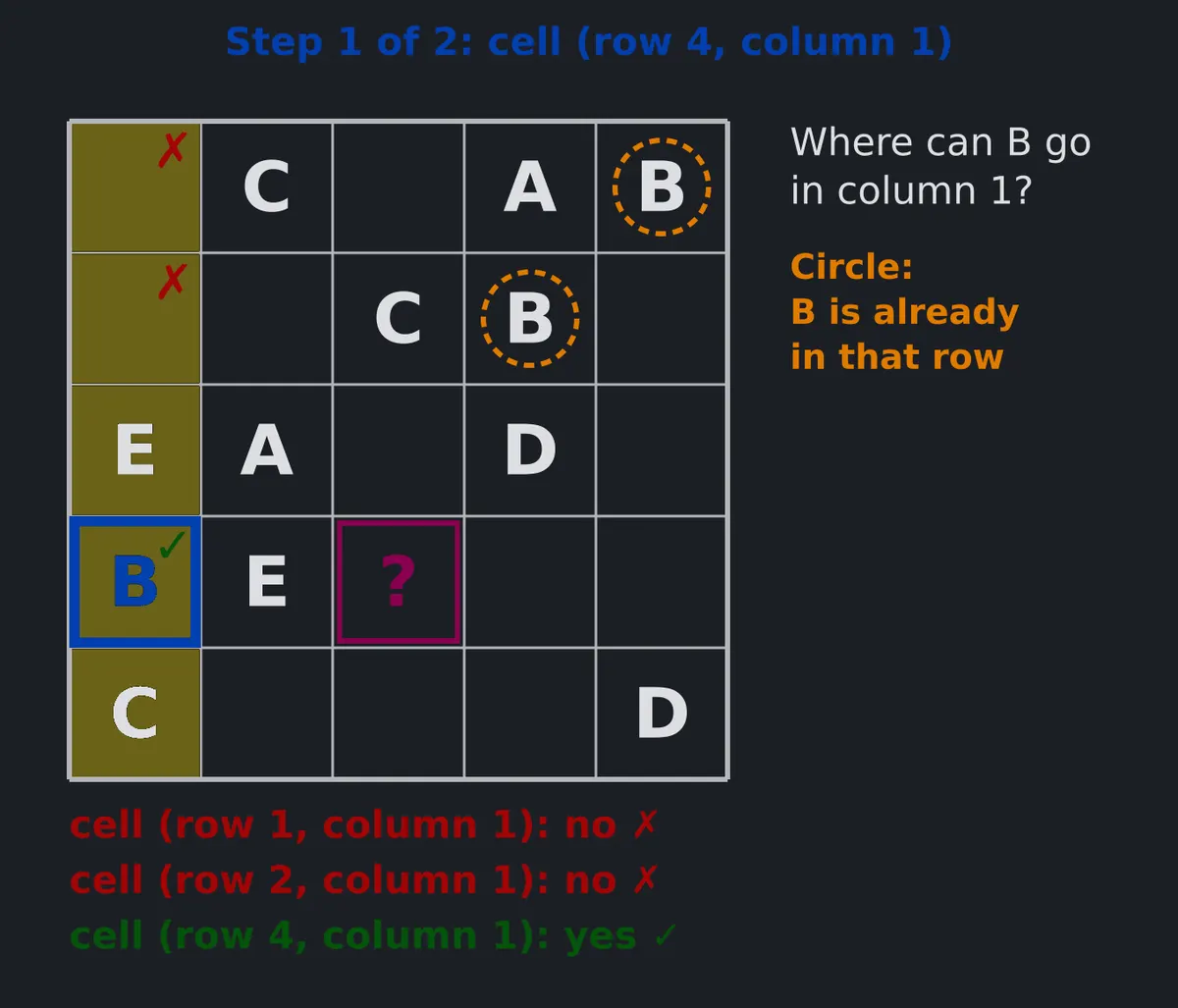
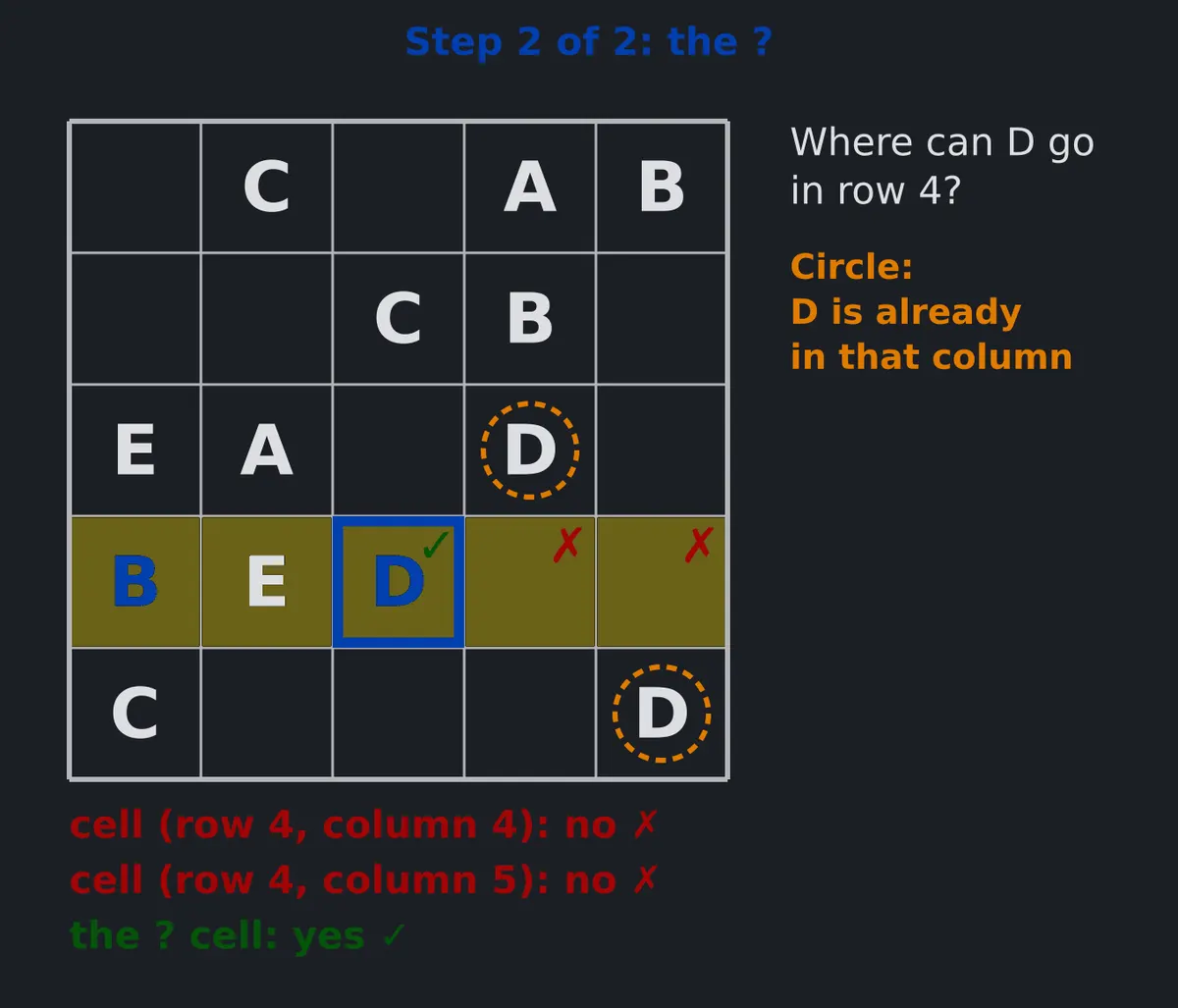
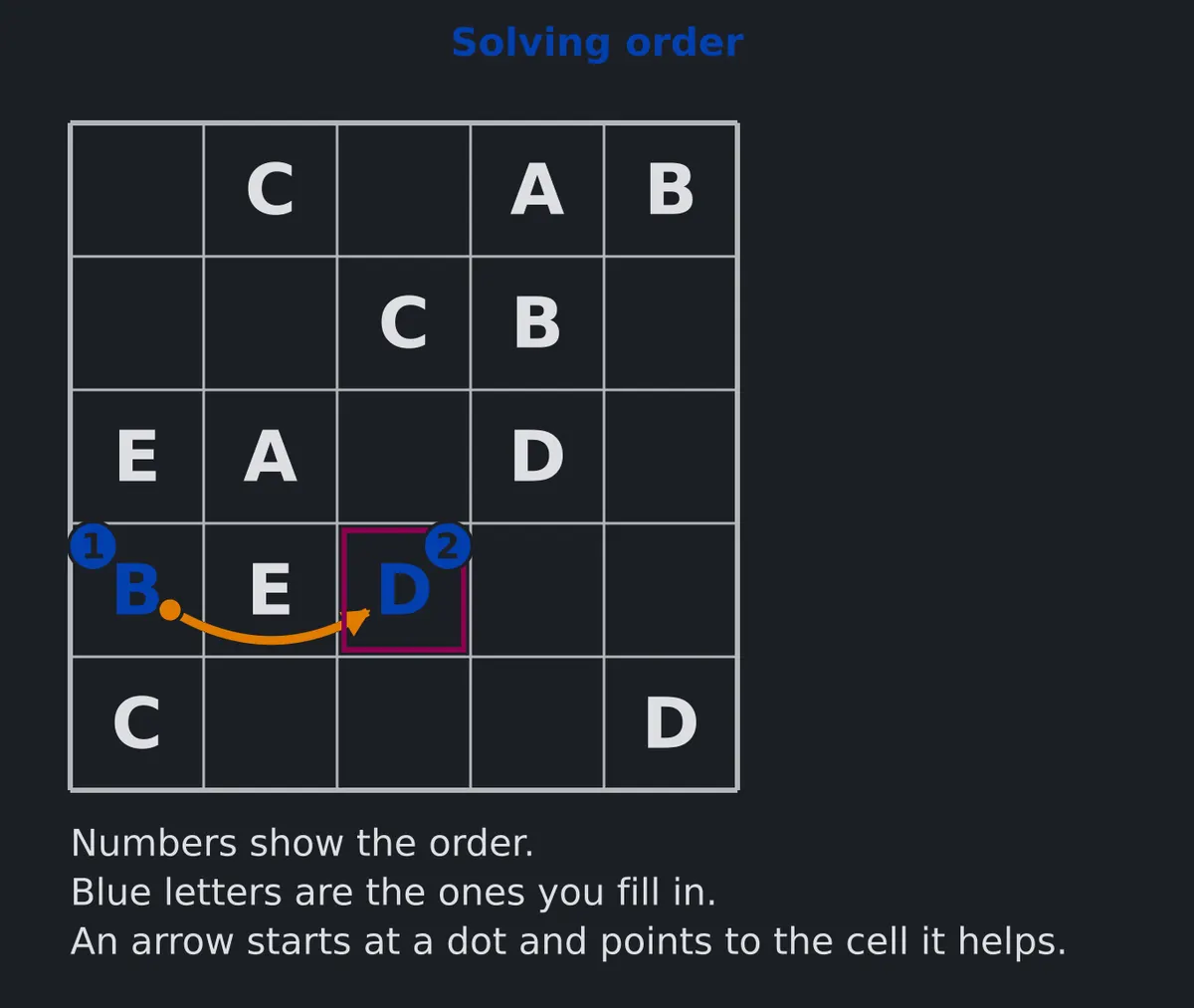
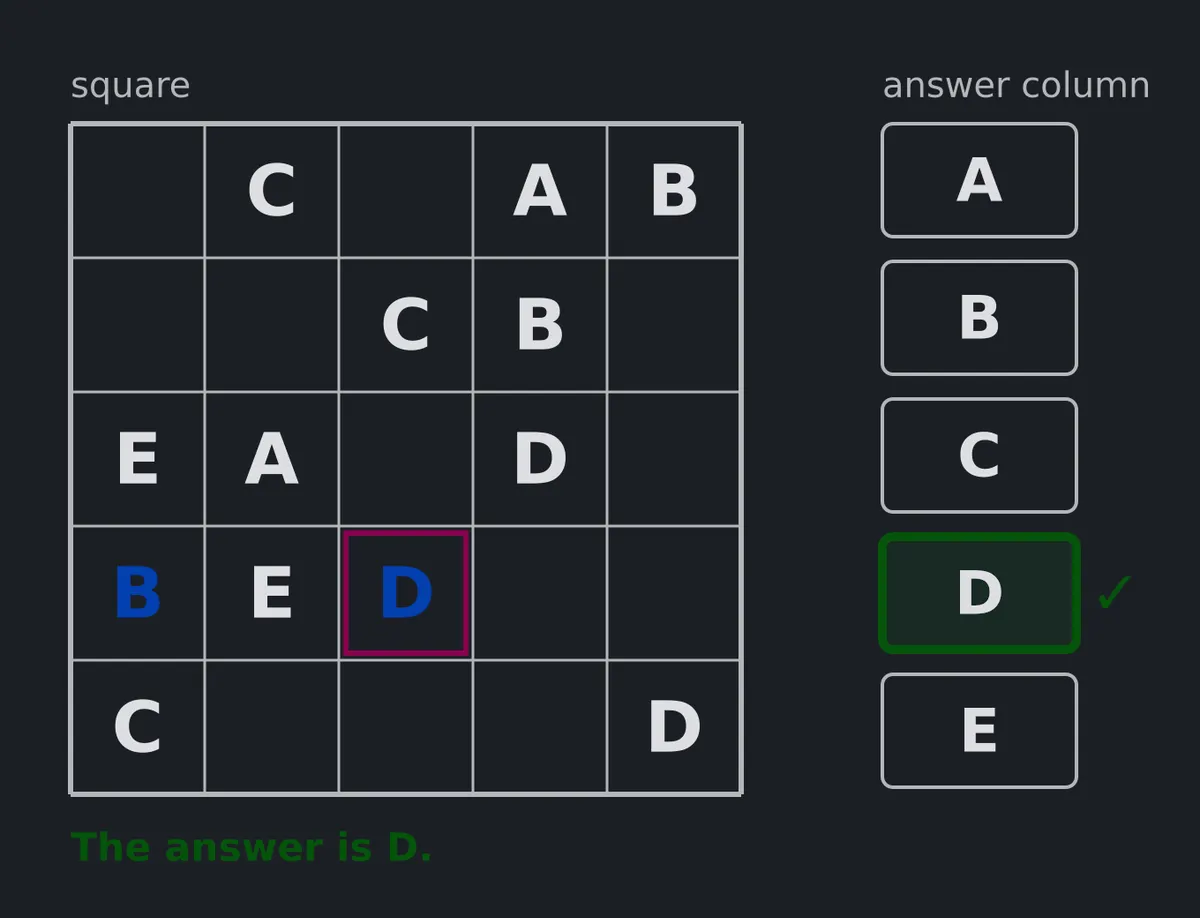
The square filled one cell at a time
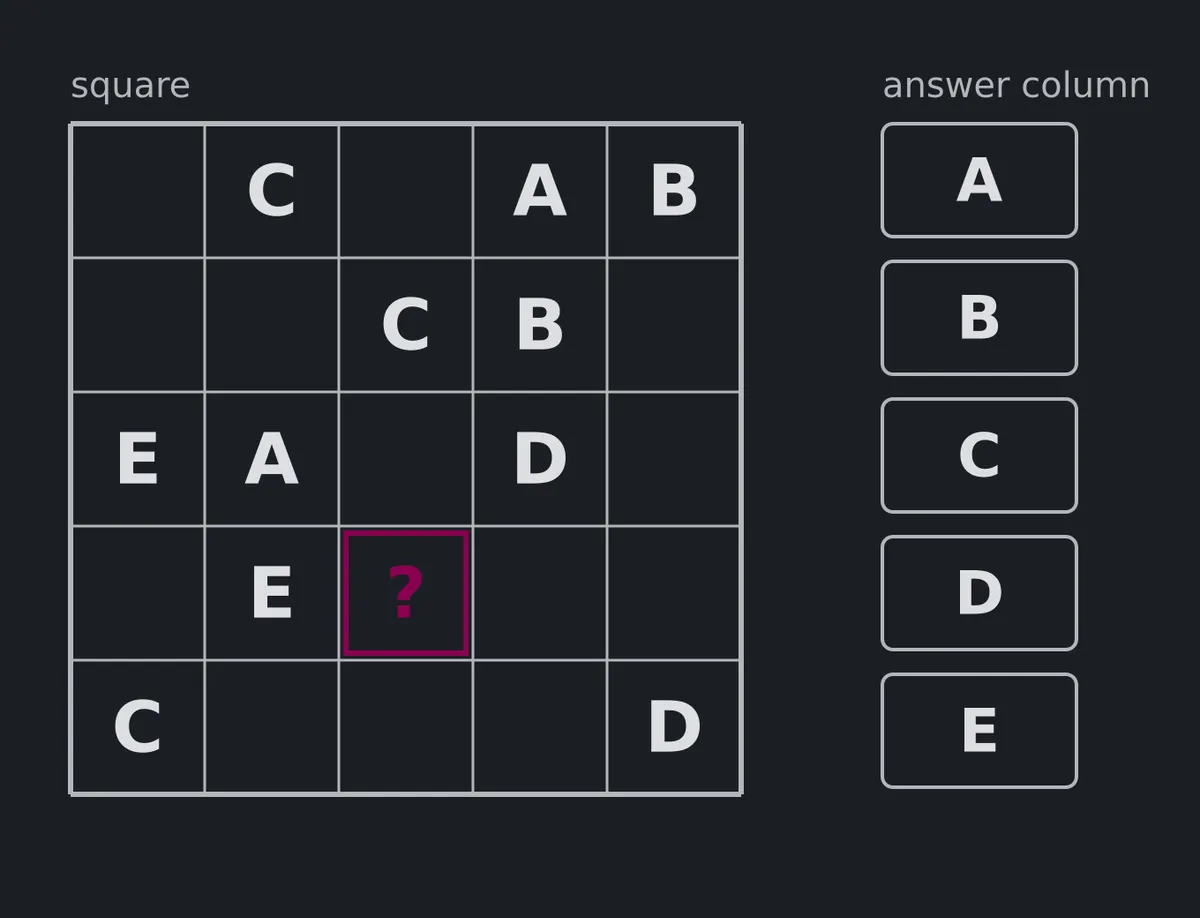
The walkthrough fills the square one cell at a time until the question mark is solved, and gives the reason for each cell: the row and column already use four letters, so the cell must hold the fifth.
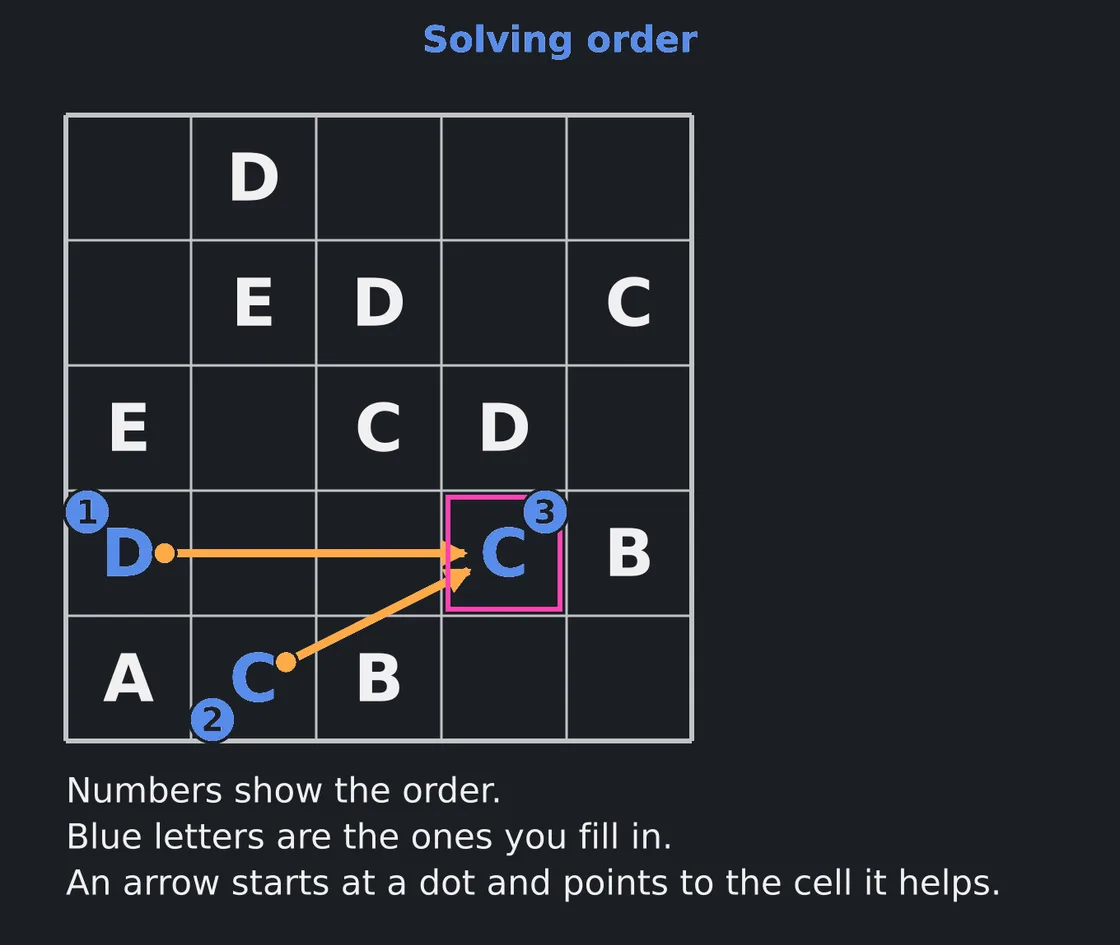
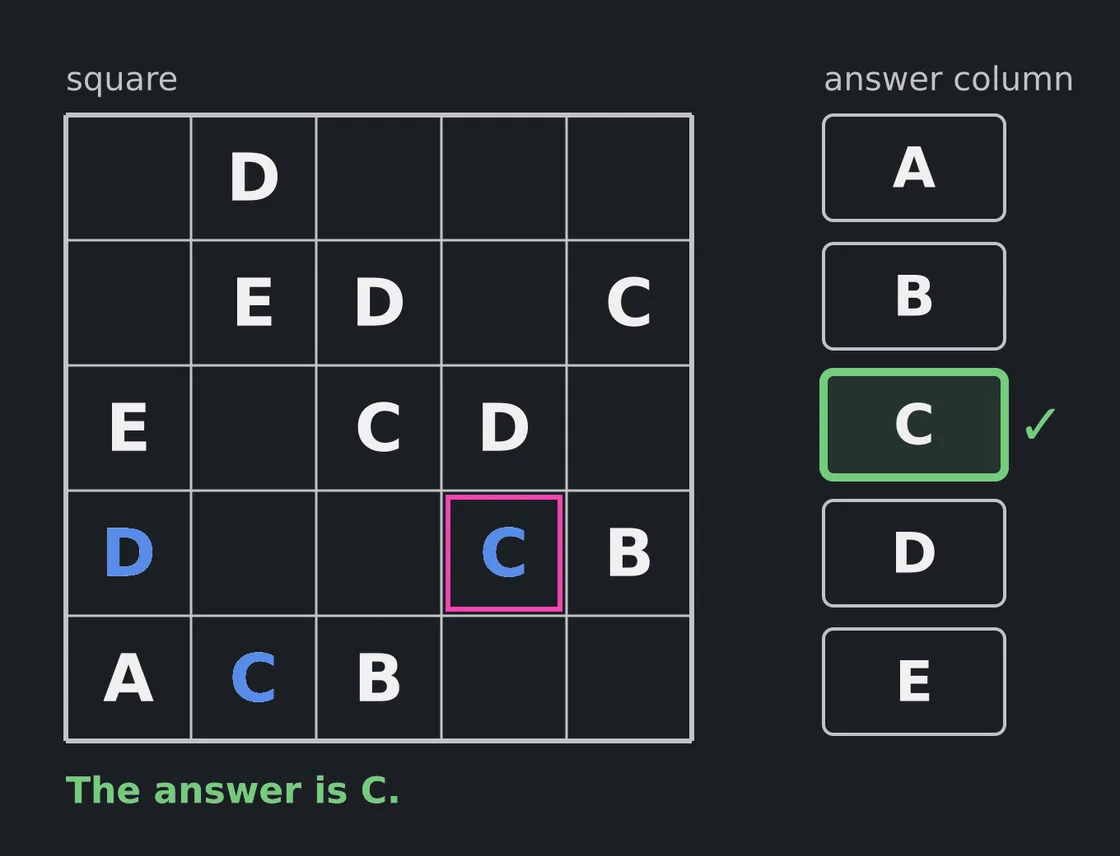
A worked example: the task on sheet 6
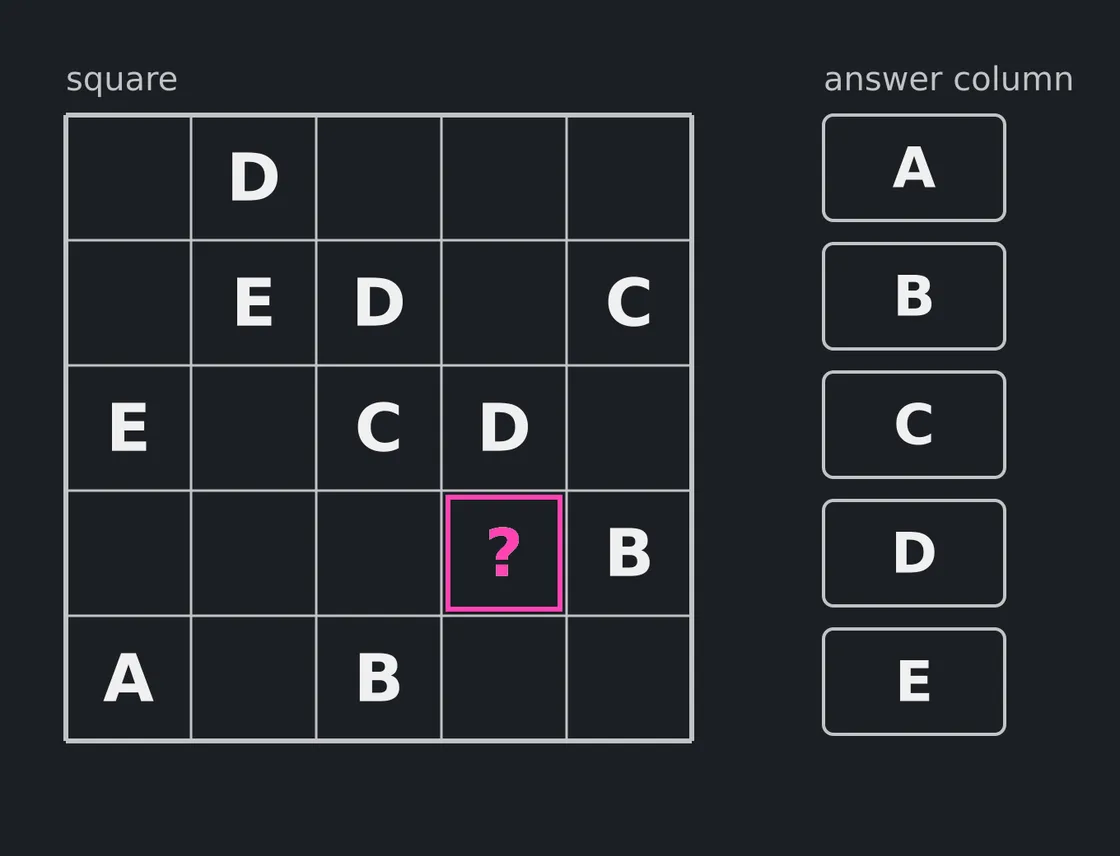
A 5 by 5 square, partly filled with the letters A to E, with a question mark in row 4, column 4.
- Row 4 holds B and column 4 holds D, so the question mark can be A, C or E. That is not enough: fill two helper cells first.
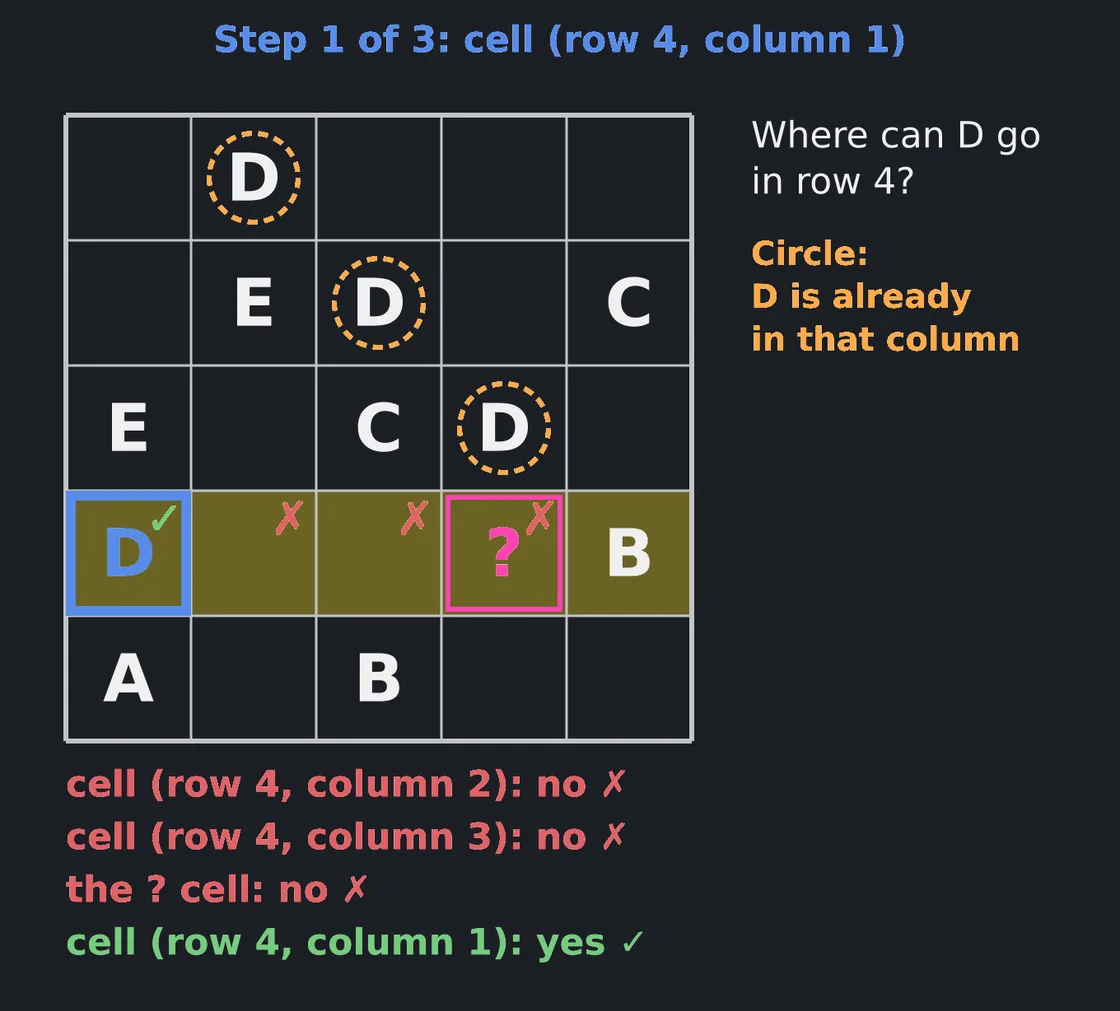
- Row 4 still needs D. Columns 2, 3 and 4 already hold D, so D can only go in row 4, column 1.
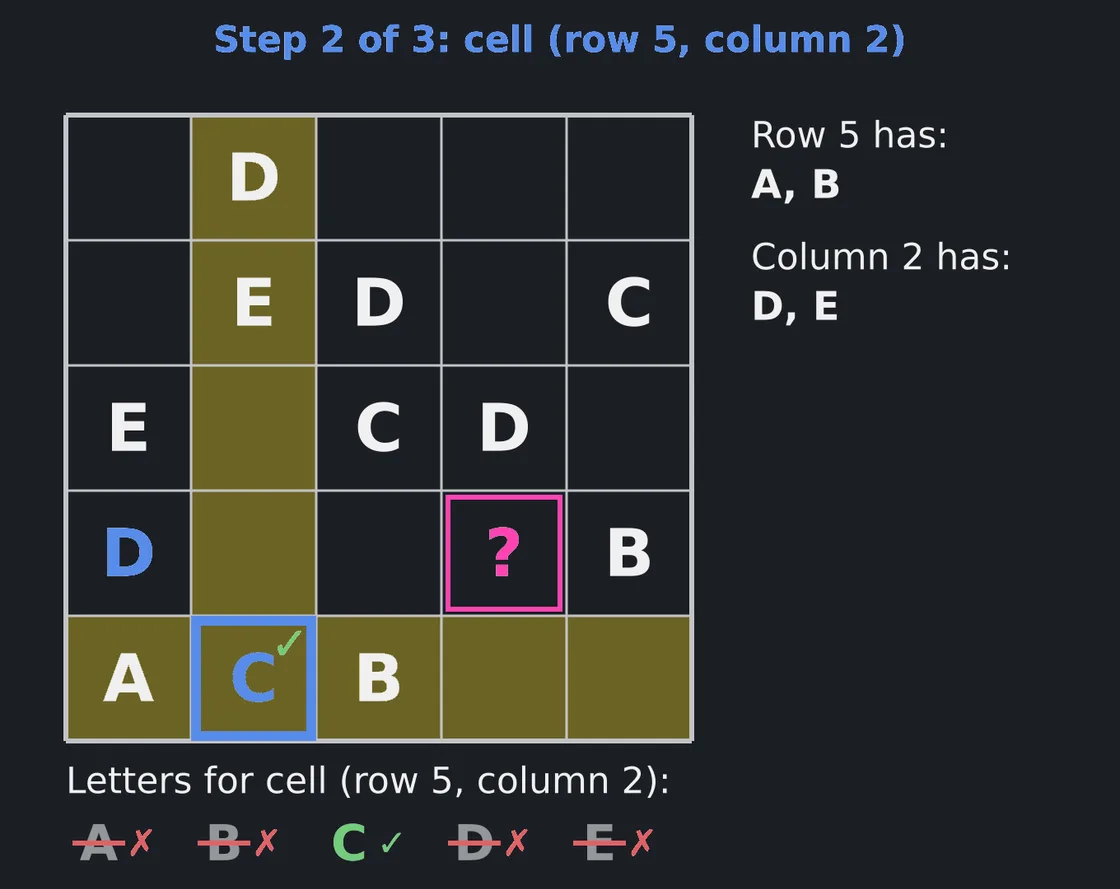
- Row 5 holds A and B, and column 2 holds D and E. So row 5, column 2 can only be C.
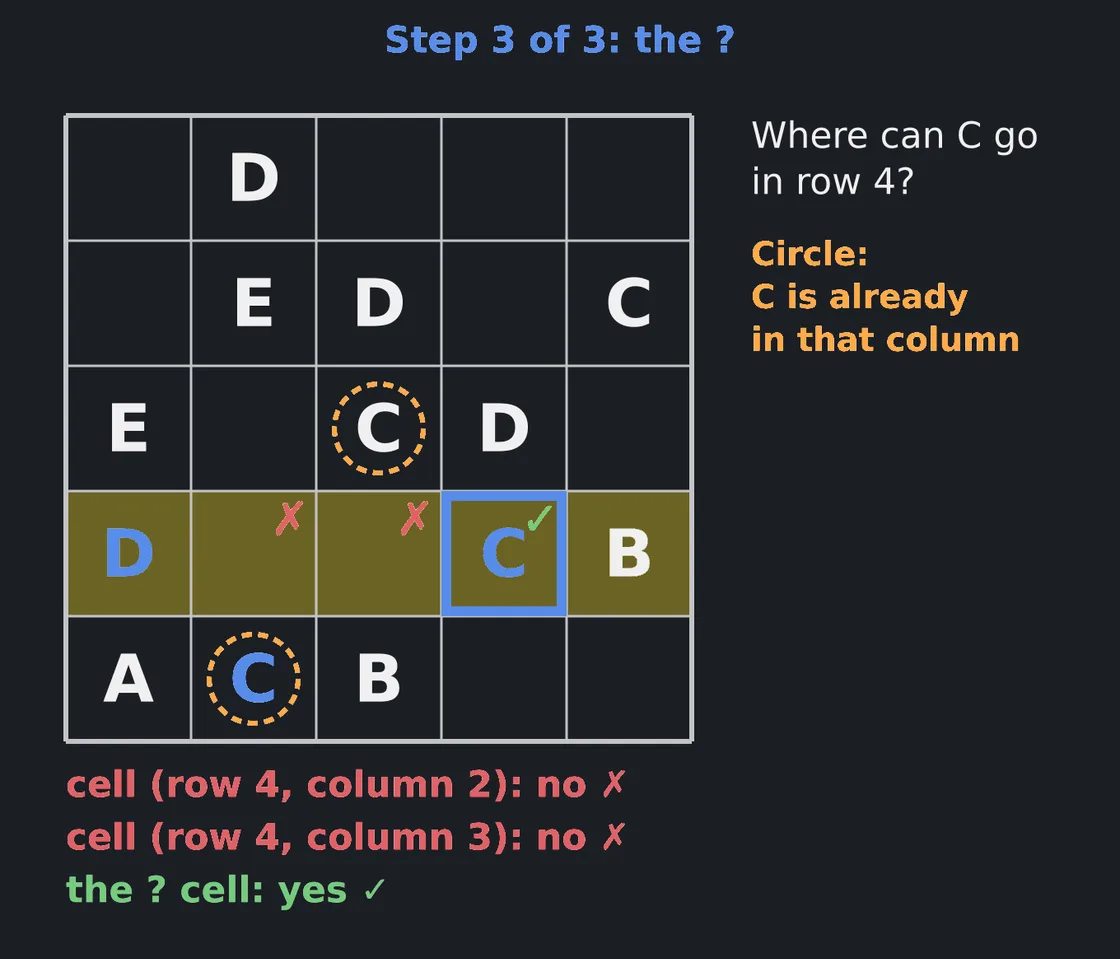
- Row 4 still needs C. Column 3 already holds C, and column 2 now holds it too, so C can only go in the question mark's cell.
Answer: C.
How does dMAT Core Module practice go from easy to hard?
Our dMAT Core Module practice puts every question at Easy, Medium or Hard. Each subtest has sets at each level, with 20 questions in 25 minutes. You start where you are sure of the method and move up as your marks rise. Your dashboard tells you when to move up a level, and when to go back down.
g.a.s.t.'s preparation material has six exercises for each subtest, two each at low, medium and high difficulty (as of 18 November 2026). Our Easy, Medium and Hard are our own labels, set when the questions are written. They are not measured against dMAT results or matched to g.a.s.t.'s levels.
- Practice: each subtest has Easy, Medium and Hard rows of sets, 20 questions in 25 minutes each, and a timed Core practice with all three subtests in exam order.
- Mock tests: each mock's card counts its easy, medium and hard questions before you start.
- Dashboard: for each subtest, a level map tells you when to move. It looks at 2 or more sets at a level: up at 80% or more, back down below 50%.




What can you use during the dMAT Core Module?
You work with the screen and your head only. The dMAT allows no written notes, and no calculator, phone or watch. Each subtest has its own clock of 25 minutes for 20 tasks, so you have about a minute and a quarter for each task. Practise under the same rules from your first set.
- No notes and no calculator. The dMAT FAQ rules out notes, and the dMAT terms rule out calculators (as of 18 November 2026).
- Guess when unsure on Figure Sequences and Latin Squares, as g.a.s.t.'s instructions say. The Mathematical Equations instructions ask you to be quick and accurate.
- The clock keeps going. Our mock keeps its clock running if you switch tabs, as in the exam.
How does our dMAT Core Module mock test mark you?
Our dMAT Core Module mock test marks you the moment you submit. Each correct answer earns one mark, so the module has 60 marks. A Figure Sequences task needs both picks right for its mark. That is our rule, because g.a.s.t. does not publish its own. Your result also gives an estimated score, labelled as our estimate.
Each mock runs the three subtests in exam order. Between them comes a two-minute break that does not use your test time. The clock turns red with 5 minutes left. After the Core Module, a 30-minute break leads into the General Academic Module. The real dMAT reports a score from 0 to 200 for each module and sets no pass mark: each university decides how it uses the score. How the dMAT score works.
What Core Module score do you need for the dMAT?
No fixed Core Module score is needed. The dMAT has no pass mark, and g.a.s.t. publishes no table that turns correct answers into a score. Your Core Module score runs from 0 to 200, with 100 as the average across all takers. Your target is what your university asks for, so check its admission rules.
The points below are in our words, from the dMAT FAQ, the dMAT site and APS India, as of 18 November 2026.
- 100 is the average. Your score compares you with every dMAT taker, at all test centres and on every test date. A score above 100 is above the average.
- The percentile rank shows your place. The certificate also gives the share of other takers with a lower or equal result. A university may select by it, for example the best 10% of applicants. RWTH Aachen University and Georg-August University Göttingen use the dMAT to select applicants.
- The Core Module has its own score. The General Academic Module gets a separate score, and the overall result is the two added. A weak Core score shows even when the total looks good.
- No APS or visa minimum. APS India says a low dMAT score does not by itself lead to a refusal of the APS certificate. The dMAT FAQ says taking the dMAT is enough for the visa.
Since g.a.s.t. does not say how many correct answers make a given score, aim to get as many right as you can in all three subtests. The estimated score on our mock is our estimate on an assumed curve, not measured against dMAT results. Is there a dMAT pass mark?
What are the common mistakes in the dMAT Core Module?
Five habits cost marks in the dMAT Core Module: spending too long on one task, leaving answers blank, practising with notes or a calculator, staying at one level, and reading only your score. Each one below says what to do instead. You can fix all five in your practice sets, weeks before the exam.
- Spending too long on one task
- Each subtest gives you 25 minutes for 20 tasks, about a minute and a quarter each. Leave a hard task, answer the rest, and come back.
- Leaving answers blank
- g.a.s.t.'s instructions for Figure Sequences and Latin Squares say to guess when you do not know an answer. A blank earns nothing.
- Practising with notes or a calculator
- The exam allows neither. Work in your head from your first practice set, so your speed in practice is your speed on the day.
- Staying at one level
- Easy sets teach the method, and they stop teaching once you know it. Move up when the dashboard says so: at 80% or more over two or more sets.
- Reading only the score
- Open the explanation for every wrong answer and follow its steps once. On Figure Sequences and Latin Squares, watch the walkthrough to the end.
Try each subtest on our screen, free and without an account: the free dMAT practice test. The full mocks are on the dMAT page.