dMAT General Academic Module: tasks, topics and practice
The dMAT General Academic Module (GAM) is the dMAT subject module for applicants from India, the second of the two modules in the digital Master Test. You get about 60 single-choice questions in 90 minutes, each with four options, on texts with figures, tables and formulas. Practise it here on our test screen, with a worked solution for every question.
Checked against g.a.s.t. on · Reviewed by Nisarg Shah
One full mock, in exam order, drawn to scale: this page covers the General Academic Module
CoreFigure Sequences20 tasks25 min
CoreMathematical Equations20 tasks25 min
CoreLatin Squares20 tasks25 min
BreakBetween modulesGAM starts by itself30 min
GAMGeneral Academic60 questions90 min
On this page
What is in the dMAT General Academic Module?
The dMAT General Academic Module is the second half of the exam. It comes after the Core Module and a 30-minute break. You get about 60 questions in 90 minutes, all in English. Each question has four options and one correct answer. The module gets its own dMAT score, apart from the Core Module's score.
The dMAT General Academic Module: its questions, time, format, topics and language
Part
What g.a.s.t. says
Questions
About 60. g.a.s.t. calls this an average: a sitting may have a few more or fewer.
Time
90 minutes for the whole module.
Format
A text, then several questions on it. Each question is single choice: four options, one correct.
In the text
Figures, tables and formulas can appear in the text, the questions and the options.
Topics
Mathematics, computational sciences, natural sciences, engineering, business administration, economics, social sciences and humanities.
What it tests
How well you use what the text gives you. g.a.s.t. calls this transfer and application, rather than facts learned by heart.
Language
English.
How much time do you get per question in the General Academic Module?
You get 90 minutes for about 60 questions, so about 1.5 minutes a question. That is our sum from g.a.s.t.'s figures. g.a.s.t. sets no time per question or per task. You share the 90 minutes across all tasks as you choose, and reading the text comes out of the same time.
Per task: with six questions a task, as in our mock, 1.5 minutes a question is about 9 minutes a task, reading time included.
Guess when unsure:g.a.s.t.'s instructions for the subject module say to guess when you do not know an answer. Our test screen repeats the line.
What does a dMAT General Academic Module question look like?
Each task is one text with the table, figure or formula it needs, followed by several questions. The text often gives you a model, such as a rule, a definition or a set of figures. The questions ask you to use that model on new numbers, compare cases or say what follows from it.
On our test screen the text sits on the left and the questions on the right. Open a question, then click its answer. In our topic practice and mocks a task is one text with six questions. Below is one of our GAM practice questions, worked step by step. In its task a field station plans food, water and fuel with direct proportion, and a meadow survey with inverse proportion.
07:49
07:47
07:52
Core Module
General Academic Module
Mathematics and quantitative modelling
Choose the right answers.
Every task gives a short text followed by a few questions on it.
Open a question by clicking it, then click the answer you think is right.
Only one answer to each question is right.
Not sure? Make your best guess. Click a figure to see it larger.
Planning Supplies and Survey Work for a Field Course
A university field station is planning a 5-day ecology course for 24 people (students and staff). The planners use two simple models.
Direct proportion. Two quantities y and x are directly proportional if y=kx for a fixed constant k: doubling x doubles y, and the ratio y/x never changes. Food, water and fuel are treated as directly proportional to the number of person-days, defined as the number of people multiplied by the number of days. For example, 10 people staying 3 days account for 30 person-days.
Inverse proportion. Two quantities are inversely proportional if y=k/x, so that their product xy stays the same: doubling x halves y. A survey of the station's meadow is a fixed amount of work, measured in team-hours (one team working for one hour). The work is shared equally among identical teams that all survey at the same rate and work at the same time, so the time needed is inversely proportional to the number of teams.
Item
Planning figure
Drinking water
3 L per person per day
Rice
0.15 kg per person per day
Stove fuel
1.2 kg per 20 person-days
Meadow survey
48 team-hours of work in total
Table 1. Planning figures used by the field station.
07:46
07:51
ModuleGAMScreenQuestionSheet1
A General Academic task on our test screen, on a phone: it opens on the planning text and its table, and the cursor changes the text size.A General Academic task on our test screen: the planning text and its table, then six questions. The first is open, and the cursor picks its answer: the number of survey teams and the time the survey takes.
A worked example: question 3 on sheet 1
The station had planned 6 survey teams for the meadow, but only 4 are available. How long will the survey take? The options are 5.3 h, 8 h, 10 h and 12 h.
Find the fixed amount in the table: the meadow survey is 48 team-hours of work in total.
The text says the time is inversely proportional to the number of teams, so teams × hours always gives 48. That makes the time 48 ÷ the number of teams.
With the 6 teams planned: 48 ÷ 6 = 8 hours. With 4 teams: 48 ÷ 4 = 12 hours. A quick check: fewer teams must take longer, and 6 ÷ 4 = 1.5, so 8 hours becomes 12.
Our solution then gives one line for each option:
5.3 h: Wrong. It takes 8 hours × 4/6, as if fewer teams finished sooner. That treats the time as directly proportional.
8 h: Wrong. That is the time with the 6 teams first planned. It stops one step early.
10 h: Wrong. It adds one hour for each missing team. Under inverse proportion the time is multiplied by 6/4, not added to.
12 h: Correct. 48 ÷ 4 = 12 hours.
Answer: 12 hours. Nothing here needs outside knowledge: the table gives the 48 team-hours, and the text gives the rule.
What topics does the dMAT General Academic Module cover?
g.a.s.t. lists these topic areas: mathematics, computational sciences, natural sciences, engineering, business administration, economics, social sciences and humanities. It publishes no fixed list of subjects. A task can come from a field you never studied. The text gives you the model you need, so you are tested on how you use it.
For your practice, our topic practice puts its tasks into eight practice areas: mathematics, physics, economics and finance, chemistry, computer science, biology, academic skills and the social sciences. This is EEC's own grouping. It is not g.a.s.t.'s list of GAM topics, and it does not predict the topics in your exam.
Each topic has three tasks, one at each of our levels. Every task is one text with six questions. Its card shows its time: about 7 to 8 minutes for an Easy task, and up to about 14 minutes for a Difficult one.
ModuleGAMScreenTopic practiceSheet2Our General Academic practice page: the practice areas across the top, the difficulty filter, then each topic's Easy, Medium and Difficult tasks, six questions each, with their times.
How hard are the General Academic Module questions?
g.a.s.t. warns that its sample questions may not show the difficulty of the actual exam. Our practice and mocks show our levels: Easy, Medium or Difficult on each topic task, and a count of easy, medium and hard questions on each mock. Our editors set these levels when they write the tasks. They are not calibrated against dMAT results.
Topic practice: filter by Easy, Medium or Difficult, in one practice area or all eight. Start where you get most questions right, then move up.
Unrated practice: more tasks after each area's topics, with no level. These run at 1.5 minutes a question, the exam's pace.
Mock tests: each mock's card counts its easy, medium and hard GAM questions before you start. Mock 1, for example, has 16 easy, 30 medium and 14 hard.
What does our worked solution show for each GAM question?
After a mock, and after you hand in a topic practice task, your result gives a written solution for every question. It has six parts, from the correct answer to the trap to watch for. The solution is text with the task's still figures. Only two Core subtests, Figure Sequences and Latin Squares, have an animated walkthrough.
We checked our own mock data: in every mock, all 60 GAM questions have this solution. The questions and solutions are EEC's own. Each solution has these parts, in this order:
1Correct answerthe right option, and your answer if it differs
2This question checksthe skill the question tests, in one line
3How to solve itthe full working, from the text to the answer
4Quick method in the examthe short way to the answer under time
5Why each option is right or wrongone line for every option, naming the slip behind each wrong one
6Watch outthe trap that catches people on this question
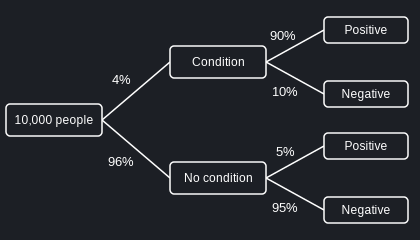
Sheet 3 shows a result. The first question of the screening task asks how many of 10,000 people truly have the condition, when the prevalence is 4%. The solution works 4% of 10,000 = 400, gives the quick method (1% is 100, so 4% is 400), and says why 500 is wrong: it takes the 5% false-positive rate instead. "Watch out" names the trap: confusing the prevalence with one of the test's error rates.
Task 1: Screening Tests and Bayesian Updating (6 / 6)
Show the text
A screening programme uses a binary medical test: each result is either positive or negative. A positive result does not by itself prove that a person has the condition. It has to be read together with how common the condition is in the tested population.
Three numbers describe the test in this population. The prevalence is 4%: 4% of the people tested truly have the condition. The sensitivity is 90%: 90% of people who have the condition test positive. The specificity is 95%: 95% of people who do not have the condition test negative, so the false-positive rate is 5%.
The probability that a person with a positive result truly has the condition is called the positive predictive value. Bayes' rule gives it:
P(D∣+)=P(+)P(+∣D)P(D)
Here D means that the person has the condition and + means a positive result. P(+) counts positives from both groups: true positives from people with the condition and false positives from people without it. If two test results are conditionally independent, multiply their probabilities within each group (with the condition, without it) before applying Bayes' rule.
Figure 1. Tree diagram for 10,000 people tested. Each branch shows the proportion of the group it comes from.
Q1: In a group of 10,000 people with the stated prevalence, about how many truly have the condition?
a)200
b)500
c)400your answer
d)9,600
Correct answer: C) 400
This question checks: Reading a stated rate and turning it into a count (comprehension and simple quantitative work).
1. How to solve it
The prevalence is 4%, so 0.04×10,000=400 people have the condition.
2. Quick method in the exam
Take 4% of 10,000: 1% is 100, so 4% is 400.
3. Why each option is right or wrong
A) 200Wrong
Uses 2% instead of the stated 4%.
B) 500Wrong
Takes 5%, which is the false-positive rate, not the prevalence.
C) 400Correct(your answer)
4% of 10,000 is 400.
D) 9,600Wrong
This is the number of people WITHOUT the condition (96%).
Watch out
Confusing the prevalence with one of the test's error rates.
The General Academic result of a sample mock: marks out of 60, percent correct, correct answers in each of the ten tasks with its subject, then the worked solution for each question.
The unrated practice tasks have a shorter written explanation, without these parts. Ask Teacher, our AI tutor, helps in practice, and after a mock it goes through your mistakes with you, up to 100 messages a day each.
How does the dMAT General Academic Module mock test work?
Each of our mock tests runs the dMAT in exam order: the Core Module, a 30-minute break, then the General Academic Module. The GAM starts by itself when the break ends. It has ten tasks, 60 questions in 90 minutes. It is marked the moment you submit, with one mark for each correct answer.
Your result gives an estimated score for each module. It is labelled as our estimate, not a dMAT score. Take a mock again as often as you like while your plan runs. A retake shows the same questions, so it shows what you learned from the solutions. The clock rules and breaks are on the dMAT page.
Part 1, the Core Module: three sections of 20 questions, 25 minutes each. Part 2 (Mock Tests 1–10), the General Academic Module: 60 questions in 90 minutes, after a 30-minute break. You see your score and explanations at the end.
Mock tests follow the exam order and clock, with no teacher. When you finish, Ask Teacher goes through your mistakes with you.
Mock tests
dMAT Mock Test - 1
120 questions2 modules
Core Module (3 × 20 tasks, 25 min each) · 30-minute break · General Academic Module (60 questions, 90 min)
Core Module: 6 easy · 24 medium · 30 hard
General Academic Module: 16 easy · 30 medium · 14 hard
ModuledMATScreenMock testsSheet4Our mock tests page: each mock with its Core Module and General Academic Module, and how many easy, medium and hard questions each holds.
What General Academic Module score do you need for the dMAT?
No fixed General Academic Module score is needed. The dMAT has no pass mark, and g.a.s.t. publishes no table that turns correct answers into a score. Your GAM score runs from 0 to 200, with 100 as the average across all takers. Your target is what your university asks for, so check its admission rules.
100 is the average. Your score compares you with every dMAT taker, at all test centres and on every test date. A score above 100 is above the average.
The GAM has its own score. The Core Module gets a separate score, and the overall result is the two added. The certificate also gives a percentile rank: the share of other takers with a lower or equal result.
No pass mark for APS. APS India says the dMAT is not a stand-alone pass or fail test, and each university decides how it uses your score. A university may select by percentile rank, for example the best 10% of applicants.
Since g.a.s.t. does not say how many correct answers make a given score, aim to get as many right as you can across all the tasks, in subjects you know and ones you do not. The estimated score on our mock is our estimate, not a dMAT score. Is there a dMAT pass mark?
What are the common mistakes in the dMAT General Academic Module?
Six mistakes cost easy marks in the General Academic Module. Three are about reading: answering from outside knowledge, misreading a rate and reading the whole text too closely. Two are about time: staying too long on one task and leaving blanks. The last is about review. Each comes with what to do instead.
Answering from what you already know
Every question is about the model in its text. If the text says the time is inversely proportional to the number of teams, use that rule, even if fieldwork outside the text would not work so neatly.
Misreading a rate
Check what each figure is per. In the planning task the stove fuel is 1.2 kg per 20 person-days, not per person-day: reading it wrong gives 144 kg instead of 7.2 kg.
Reading the whole text closely before the first question
Skim the text and its table or figure once. Then read closely only what each question needs. With about 60 questions in 90 minutes, a slow first read costs you several questions at the end.
Staying too long on one task
Our mock has ten tasks of six questions, about 9 minutes a task. If a task is in a subject you find hard, answer what you can, guess the rest and move on.
Leaving answers blank
g.a.s.t.'s instructions for the subject module say to guess when you do not know an answer. A blank earns nothing.
Reading only the score
Open the solution for every wrong answer and read the line for the option you chose. It names the slip, so you can stop making it.
What do students ask about the dMAT General Academic Module?
What is the dMAT General Academic Module?
The General Academic Module (GAM) is the subject module of the digital Master Test (dMAT) for applicants from India. It has about 60 single-choice questions in 90 minutes. Each question has four options and is set on a text with figures, tables or formulas. The GAM gets its own dMAT score, apart from the Core Module's score.
Is the dMAT subject module the same as the General Academic Module?
Yes, for applicants from India. g.a.s.t. calls the second module of the dMAT the subject module, and for them it is the General Academic Module, given in English.
How many questions are in the dMAT General Academic Module?
About 60, in 90 minutes. g.a.s.t. says 60 is an average, so a sitting may have a few more or fewer. That is about 1.5 minutes a question.
What topics does the General Academic Module cover?
g.a.s.t. names mathematics, computational sciences, natural sciences, engineering, business administration, economics, social sciences and humanities. The questions test how you use what the text gives you. Our eight practice areas are EEC's own grouping to help you plan. They are not g.a.s.t.'s list.
Can I use a calculator in the General Academic Module?
No. The dMAT terms allow no calculator and no notes. Practise the arithmetic in your head, as the Core Module page explains.
Are your GAM solutions animated?
No. Each GAM solution is written text. It gives the working, a quick method, a line for every option and the trap. Figures are still images. Only two Core subtests, Figure Sequences and Latin Squares, have an animated walkthrough.
10 full mock tests, unlimited takes of each, each marked at once with an estimated dMAT score, for the whole plan period.Core and General Academic, with practice by subtest and level and a step-by-step solution for every Core question, for 180 days.